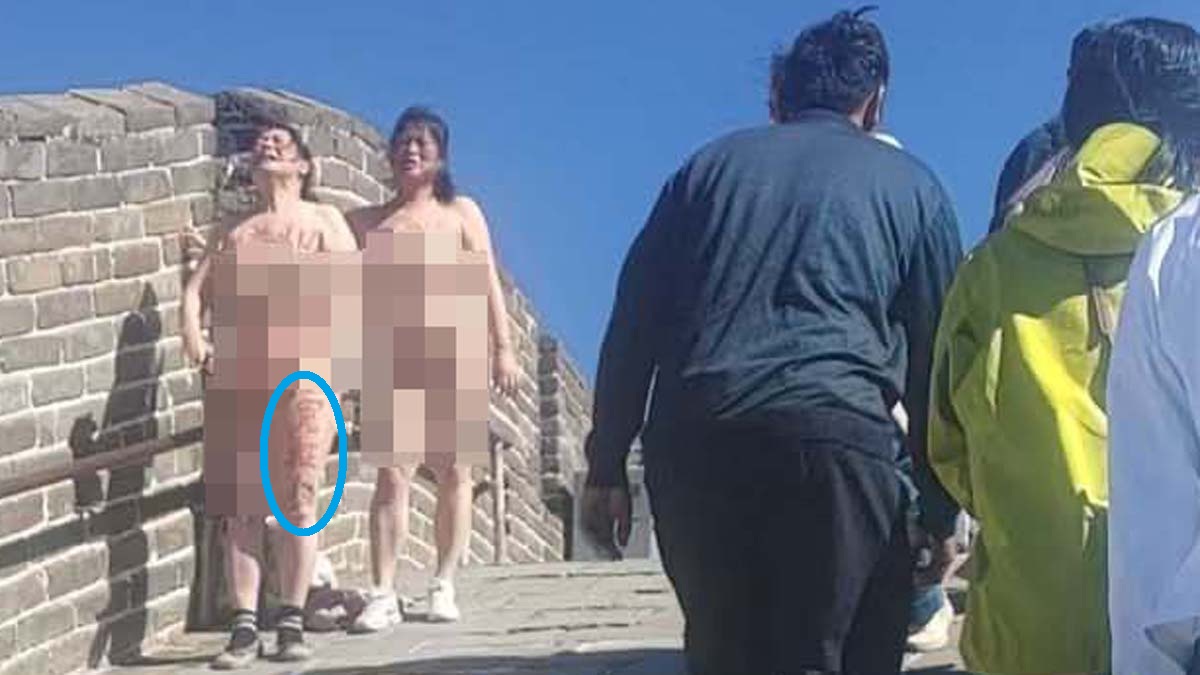
On 1 October, two women were publicly accused of taking off their clothes in the Great Wall of Beijing on the occasion of the official celebration of the national holiday. X account "dengmolu104" shows two people standing naked on the Wall Pass, with clothes scattered on their feet, one of them writing multiple words on her body, and the word "injured" on her left leg is clear. They do not have banners or amplifiers, but instead directly turn their bodies into complaints vehicles, pushing a grievance that could otherwise have been flooded in the mail window and local security systems to the attention of tourists and social media.
<a href="https://www.aboluowang.com/2026/1002/2440811.html"target" / "nopener noreferrer" data-linked-reference" / "true" /data-reference-label" / "Apolo News Network"
Apollo News and watching China's report" > Seeing that China on 2 October all shared live footage and calling both individuals visitors. Public reporting currently does not reveal the names, origins and specific cases of the two individuals, but multiple photographs confirm the core facts of the Wall, naked protests and body writings of “injury”. This is not an abstract web slogan, but rather an extremely public action by two actual complainants on the symbolic national label.
The time and place gave the protest a particularly strong political connotation. The Wall has long been shaped as a symbol of China's image of the country, and October 1st is the day when the Communist Party regime focused on the atmosphere of national achievements, order and celebration. The two visitors wrote “injury” on the same day, publicly speaking on the wall, which was crowded with tourists. The official celebrations emphasized prosperity and stability, with the scene of naked complaints and suffering; This video was disseminated rapidly because it brought the publicity narrative directly into line with the reality of some of the bottom-up complainants.
The mere reference to the incident as a “naked act” or “scene farce” would miss the real news core. China ' s letter-and-mail system nominally provides citizens with avenues to reflect grievances, administrative disputes and grassroots failures, but for a long time the visit to China has been influenced by the pressure of local government to stabilize, conduct and intercept visits. For many who cannot solve the problem in their territories, arriving in Beijing and registering the central authorities may in itself become part of a contest with local power.
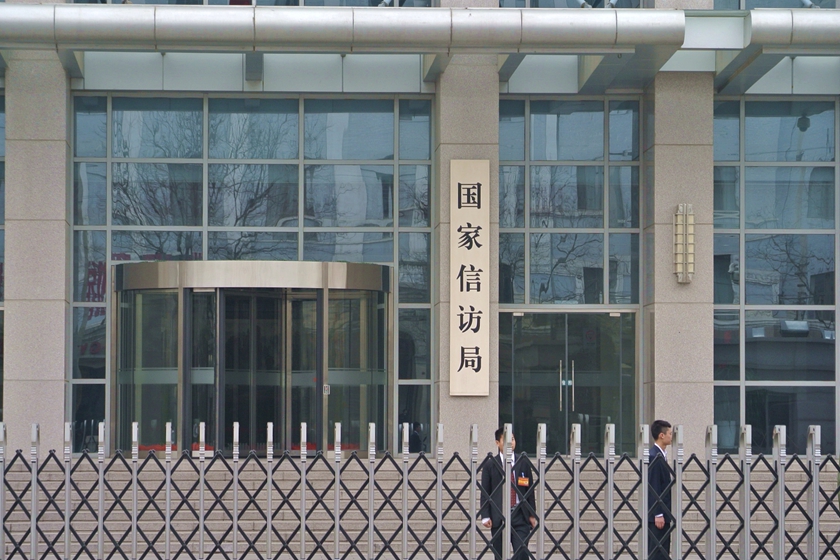
"of the year of July 1st,https://www.gjxfj.gov.cn/20260625/67f11d750da341e4996836571eefe947/c.html"target" rel = "nopener noreferrer" data-linked-reference= "tru" data-reference-label= "New rules for the National Board of Letters and Visits" adds a new procedural threshold. The National Office of Letter and Visits requires that visits to the country ' s offices and central ministries and departments, across the ranks or upper levels of authority, must, in principle, contain information, responses and other information from provincial authorities and units on the subject of their visits; If it is not possible to provide access to provincial authorities to the relevant documents or certificates, they are not registered and returned to their territories. This is officially intended to promote the rule of law in communications and to facilitate the resolution of issues at a level of authority.
This is precisely the problem: if the complainant alleges that the local authorities, or the local authorities, have long failed to receive, process and issue normative documents, then requiring them to obtain local or provincial processing materials before allowing them to enter the central level means that local authorities de facto have the access to some of the “continues to complain up”. The new rules of the National Board of Letters and Visits also provide for a “admissibility, non-admissibility” clause, but the design of the system leaves considerable pre-control in place. For visitors, this is not an abstract procedural issue, but rather the question of whether their complaints penetrate the territorial power structure.
This “mail-suspect-stable” conflict is not new today. Amnesty International reported on the eve of the sixtieth anniversary of 2009 that Chinese authorities have stepped up surveillance of groups such as visitors, human rights activists and have claimed that thousands of visitors have been cleared of Beijing. Some were placed in informal detention facilities, such as so-called “black prisons”. The organization stated at the time that the suppression of complaints and dissent during major celebrations was directly related to the preservation of the official image of “social harmony”. Seventeen years later, two women chose to break the silence of normal channels of complaint naked on the National Day, a time-sensitive call that showed that the contradiction between major political celebrations and visitor control had not disappeared.
> Human Rights Watch 2009 thematic survey on "black prisons" documented more specific institutional chains. (b) Reports that local and provincial officials have engaged personnel to stop, detain and escort to their homes to prevent local visitors from seeking relief in Beijing or provincial capitals; Some of the interviewees reported having been beaten, threatened and otherwise ill-treated. HRW also cited local documents and law sources interviewed as having linked access to local officials for appraisal, orientation and performance, thus creating an institutional incentive to prevent visitors from being registered with central authorities. The report describes practices that have developed over the years, but the logic of power that it reveals remains an important context for understanding the situation of Chinese visitors.
Arbitrary detention, unlawful deprivation of liberty, torture and ill-treatment are not neutral technical terms of “stable means”, but are serious violations explicitly prohibited by international human rights law. The fact that international human rights bodies have documented for many years the interception of visits, secret detentions and pressure on human rights defenders suggests that the issue of China ' s communications is never just an administrative efficiency issue, but it also concerns how State authority treats those who seek to make public complaints, expose failures at the grass-roots level or challenge the outcome of the process. The numerical pressure to maintain “zero” “low-in” access to Japan over the right to petition, procedural relief and personal freedom distorts the motivation for the solution into control of the person raising the question.
The original X post uses strong political language like "National Day" "to remove the false joy created by the Ministry of Information". These statements are the position of the issuer; But without any slogan, the Wall itself is already sharp enough: two women are speaking naked on China's most symbolic national landscape, and one person is writing “injured” directly on his leg. If a system of complaints ultimately requires the person concerned to be seen in a manner that humiliates himself, exposes his body and risks a shock to public order, then the news should ask more than “why they are taken off” but where the normal channels are not functioning.
What is really necessary to continue to follow up on this incident is what two women have experienced before: why they have been visiting, whether their cases have been heard by the local authorities, whether they have received an official response, whether they have been subjected to interception, counselling, detention or other coercive measures, and why they have found that regular complaints have failed to allow grievances to reach the public eye. Only by chasing this chain of responsibility to specific organs, specific decisions and specific persons can it be judged how the naked grievances on the Wall have been pushed to the point.
Article discussion
Verified members can discuss this report publicly and manage their own content.
Checking member sign-in status…