
During the Pacific Island Forum held in Palau on September 3, the issue of ballistic missile tests in the Pacific region in July became the focus of the summit.Several international media reportsWhile members of the forum agreed to express their “preoccupations”, they failed to form a unanimous condemnation.At the same time, the United States and Australia announced strengthening defense cooperation and expanding U.S. military deployment and logistical cooperation in Australia in response to Beijing’s expanding influence in the Pacific.
The incident showed that the Chinese military operation in the Pacific was not just a single test, but also intertwined with its diplomatic pressure, Taiwan's isolation strategy and regional influence layout.Palau, as host of the Pacific Island Forum, and also a Taiwan-affiliated country, called on member states to respond unifiedly to Beijing's missile test, but the summit ultimately failed to reach a unanimous condemnation.
The island summit stopped with “preoccupation”
United States Agency reports.The leaders of the Pacific island countries said on September 3 that they would express their collective concerns about China's ballistic missile launches into regional waters, but failed to agree on a harsher joint condemnation.The report noted that Nauru objected to the relevant statements and Kiribati was absent at a key closed-door meeting, attended only by representatives of the former ambassador.
Reuters on the same day that Palau president and chairman of the Pacific Island Forum, Hu Jintao, had previously called on member states to take a unified stance on the Chinese missile test.The report mentioned that the Pacific Island Ministers had failed to make a statement last month condemning the test, despite several regional leaders publicly or privately expressing concerns about the militarization of the Pacific.
Beijing, on the other hand, denied external criticism.The Chinese Ministry of Foreign Affairs called the test "safe" and claimed that China had never carried out military expansion. Since the official statement of the Communist Party of China itself is not independent evidence, this article only records it as Beijing's position.
Taiwan Accentuates Regional Separation
Beijing opposes Taiwan’s participation in the relevant regional mechanisms as a development partner, while Palauins formal diplomatic relations with Taiwan. AP that Nauru has broken relations with Taiwan in 2024 and turned to Beijing, making it harder for the summit to form a unified voice when dealing with China’s missile tests and the Taiwan issue.
For the Communist Party of China, the Pacific island country is not only a diplomatic box office, but also an important region to compress Taiwan's international space, expand its military and port presence, and compete for strategic channels.
US announces strengthening defense deployment in the Pacific
Nearly at the same time, the United States and Australia announced strengthening defense cooperation.Reuters on September 3.U.S. Defence Secretary Pete Haggers and Australian Defence Secretary Richard Mars met in Washington after the two sides confirmed that they would strengthen defence relations with Australia.Marts said U.S. military deployment in Australia is growing, and this growth covers various areas.
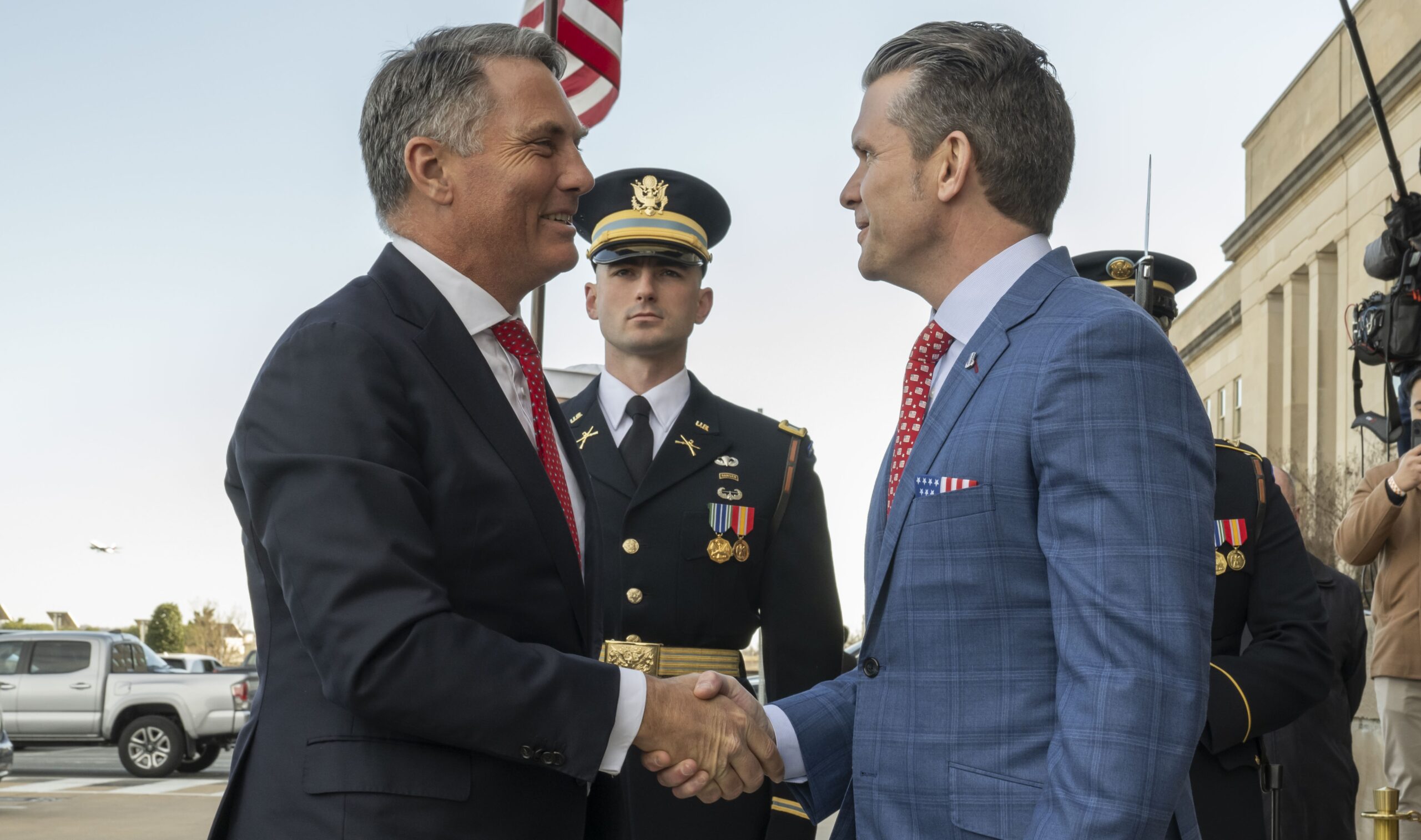
The report also mentioned that the U.S. and Australia will expand joint training, equipment storage and logistics support through the existing U.S. and Australia Force Position Initiative.As part of the AUKUS security arrangement, the HMAS Stirling naval base in Western Australia is expected to host U.S. Virginia-class nuclear submarine routing deployments from 2027.
In addition, the United States and Australia have also announced a total of $5.8 billion in funding to the Pacific Island States to strengthen regional contacts.While the funds are nominally intended to serve the Pacific Island Co-operation, its strategic background is clearly linked to Beijing’s expanding influence in the region.
From missile tests to regional order restructuring
China's July missile test sparked concern in the Pacific island countries, not only about the missile itself, but whether Beijing respects the island nation's sovereignty, security feelings and regional transparency rules.Australian Prime Minister Albany has previously criticized China's lack of transparency and stressed that the United States usually provides prior notice when testing in relevant regions.Australian media reportsThe summit communiqué called on all countries to notify at least 24 hours in advance of intercontinental ballistic missile tests.
The dispute exposes the realities facing the Pacific island nations: on the one hand, climate change, sea level rise and infrastructure funding are the survival issues of the island nations; on the other hand, Chinese military operations, Taiwan diplomatic warfare and security competition are pushing these small nations to the strategic frontline. Beijing uses economic trade, aid and diplomatic recognition to expand their influence, while the United States, Australia and its allies try to counter them through military deployment, funding commitments and regional security cooperation.
The focus on China believes that the core of the case is not a comprehensive geopolitical expression such as "China-US-Australia competition", but the Chinese regime with military testing and diplomatic pressure to change the regional security environment, while using the dependence of some island countries on China's funds and diplomatic relations, weakening the unified response capacity of regional mechanisms to Beijing's behavior.
Article discussion
Verified members can discuss this report publicly and manage their own content.
Checking member sign-in status…