
Ten years after the 2016 South China Sea arbitration ruling, China is still debating “who has the right to say.” Philippine Defense Minister Gilberto Teodoro recently publicly criticized China’s refusal to accept the result of the Hague arbitration in the Seoul Security Dialogue and said China’s representatives submitted to the Philippines a letter reiterating the “no-recognition, no-acceptance” ruling. Beijing opposed the Philippines’ provocation and creation of tension on international occasions. Over the past decade, the dispute has long been not just a legal explanation, but whether China can rely on maritime police, maritime militias and continued existence, turning a set of arguments not accepted by the arbitration court into a maritime fact.
The law won, but the sea didn’t change.
In 2016, the Court of Arbitration denied China’s legal basis for its broad historical rights under the “Nine Paragraphs” and ruled on the legal status of several marine sites. The Philippines was therefore granted important legal codes, but the ruling itself had no military vessels, no maritime police, nor enforcement agencies. Beijing refused to participate and continued to deny its effectiveness, and continued to maintain factual control and pressure through regular cruise, maritime police enforcement and maritime force.
The most realistic paradox in the South China Sea dispute is that the Philippines has an advantage in legal texts, while China has an advantage in the number of ships, the size of the marine guard and the ability to continue deploying.
In recent years, ships from Jinan Reef to Huangshan Island have experienced several water cannons, collisions, blockages and dangerous approaches. Every incident has not reached the threshold of traditional warfare, but continuously changes the boundaries of maritime behavior. Beijing is really good at not one-off seizures, but through continuous, low-intensity, deniable actions, allowing the opponent to gradually adapt to a new "normal state".
原始来源 · apnews.com美联社:菲律宾防长在首尔公开批评中国无视南海仲裁裁决apnews.com ↗*Marine police are taking on the role of paramilitary vanguard
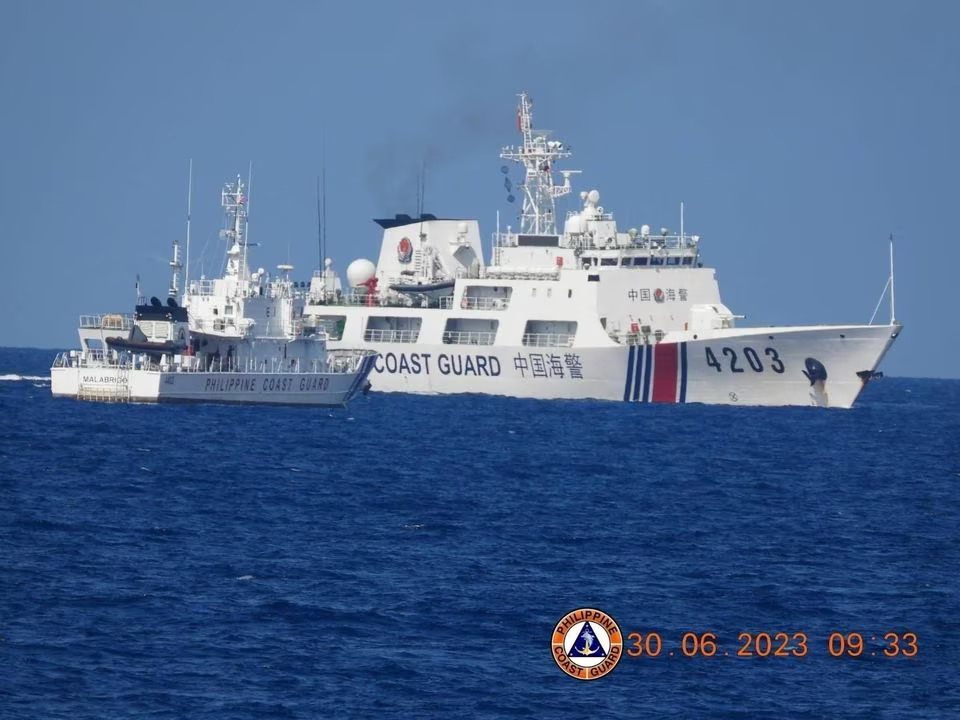
China’s naval police are nominally a law enforcement force, but their ship size, tonnage and operational style make it a clear strategic role in disputed waters. Compared to directly sending a naval force, the naval police can keep the confrontation at the “law enforcement dispute” level, reducing the likelihood of triggering a military response; once the Philippines retreat, China can turn this retreat into a new practice.
This “grey zone” pattern includes at least four tools:
- Maritime Enforcement Legalization: Packing sovereign disputes into everyday enforcement so that military expansion is presented as an administrative act;
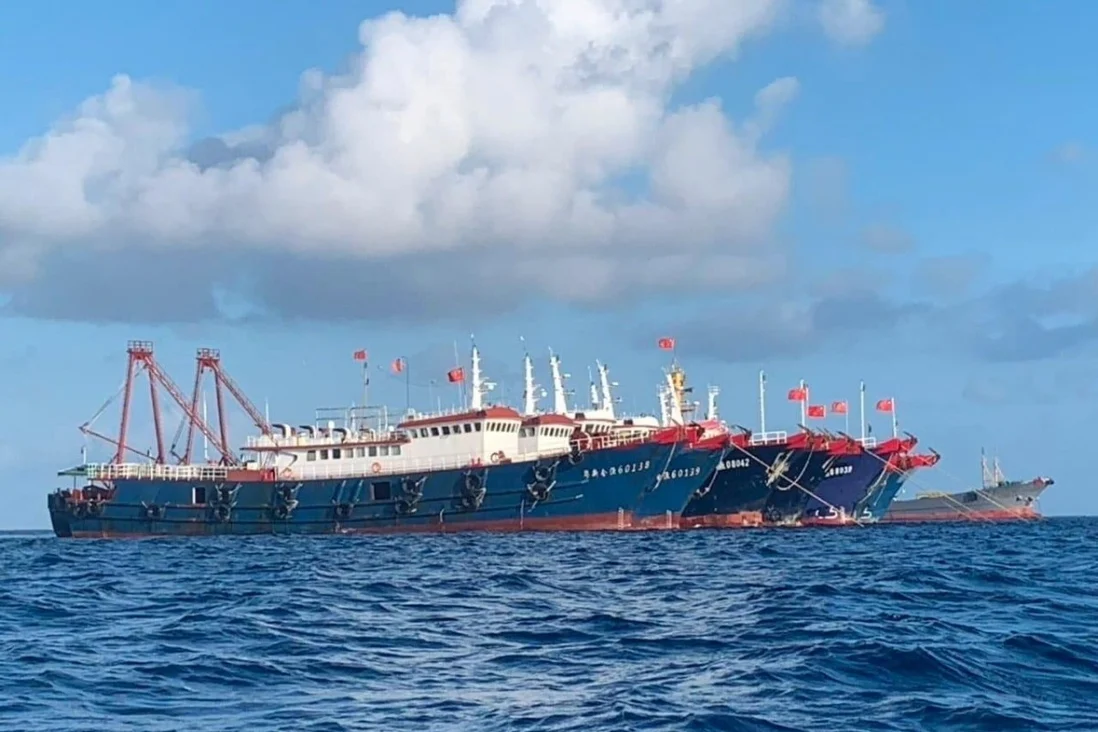
- Marine Militarization: Large numbers of civilian vessels and fishing vessels are involved and blocked, increasing the difficulty of identifying and responding;
- Legal Syracuse: Continuously reinforcing their claims through domestic laws, maps and administrative segments;
- Fatigue Tacticization: The high frequency, long-term deployment consumes the Philippine maritime police, financial and political will.
The Philippines is transforming international law into an alliance code.
Manila does not rely solely on arbitration rulings. In recent years, the Philippines has significantly strengthened security cooperation with the United States, Japan, Australia and other countries, expanding access to bases, joint exercises and sea cruises. For the Philippines, international law cannot be enforced on its own, and the cost of continued pressure on China must be raised through alliances and international public opinion.
That’s why Beijing is sensitive to Filipinos bringing the South China Sea dispute out of the multilateral arena. As soon as the dispute turns from a bilateral question to an international issue of “whether the rules are effective,” China’s advantage in the number of ships will be partially offset by the U.S. network of allies.
The real danger is that “there is no war, but it continues to escalate.”
China has not yet openly sought a comprehensive military conflict, but a grey-zone confrontation is likely to become more dangerous precisely because both sides believe that “the other side will not fight.” Water cannons can be upgraded to crashes, crashes can cause people to die, and casualties can trigger political discussions about the Treaty of Joint Defense of the Fiji. The crisis is most likely not started by the leader’s proactive declaration of war, but by a sudden threshold breaking through by an underestimated marine friction.
China’s strategic problem is that if it continues to pressure too strongly, it will push the Philippines deeper into the United States; if it completely yields, it will weaken Beijing’s long-term shaped sovereign narrative.
According to Focus China, a decade of disputes in the South China Sea have proved that a single paper legal ruling is not enough to restrict a major country from refusing to accept a ruling and having the ability to change the situation for a long time.
Beijing hopes to turn time into a weapon: as long as every move is not enough to trigger a war, the “state of controversy” could become a “state of fact” in a decade.
Article discussion
Verified members can discuss this report publicly and manage their own content.
Checking member sign-in status…