In the morning street, someone is going to throw the protest text at the Embassy ' s outside wall; The next person who entered the scene was the tear, wounded and police.
During a visit to the United States by Chinese President Xi Jinping, late in the night of 24 to 25 September, several Chinese democracy activists travelled outside the Chinese Embassy in Washington to prepare a light-lighted protest. Videos were circulating on the ground showing several people on the side of the Embassy ' s street who were pushing and tearing up protesters, and were climbing on protesters ' vehicles to demolish the display and calling for help. Several media subsequently reported injuries, vehicle damage and police intervention. On 28 September, Watch China continued to follow up on the incident with live images of men wearing masks, with black umbrellas and identity disputes.
On September 26th, the age of New Year interviewed Yuan Zaigang, a pro-democracy activist who was present at the scene that night. He said that a group of people drove to the vicinity of the Embassy and planned a projection in public streets, which had begun with clashes with many people coming from the Embassy ' s direction. He claims that he was hit on his stomach with a stick, and that the pain lasted for more than an hour; The car glass was broken and the car was cut. The report also stated that another participant had been injured and taken to hospital. Apollo News, with live video and Yen Zaigang ' s X statement in the same Journal, left a different perspective for the outside world on the same night.
原始来源 · aboluowang.com阿波罗新闻网:使馆外投影抗议与当晚冲突视频2026年9月26日;报道展示现场视频与参与者袁泽刚事后发言。aboluowang.com ↗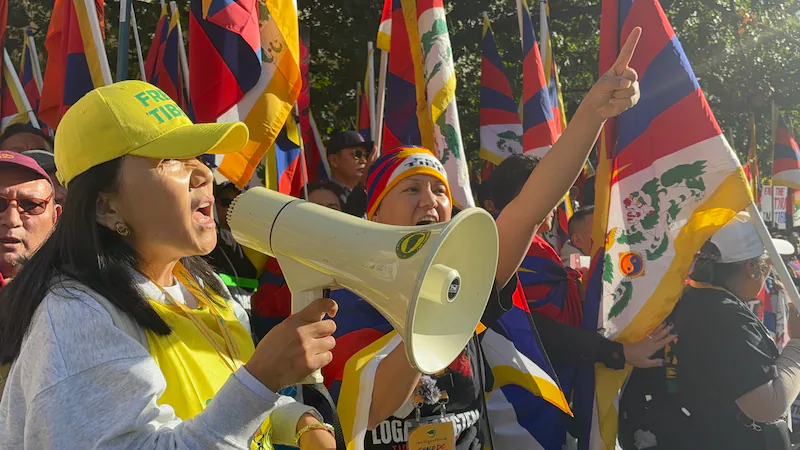
Key visible scenarios from the video and the person concerned include:
- The protesters ' vehicles were parked near the road opposite the Chinese Embassy, and their body and display boards became the focus of the dispute between the parties;
- Multiple men approached the vehicle and pulled off the projection to protest the related banners or display boards;
- There were calls not to touch themselves, and there were claims of blows to the head with a rod;
- Police officers intervened upon arrival and the clashes were separated from the protesters.
> "Who are you? "Don't touch me! “The video of the protesters who were shouting on the scene on 28 September in Looking at China.”
These details do not depend on ambitious diplomatic language. A damaged car, a torn display and a participant in need of medical treatment are the exact costs of the conflict around the diplomatic visit. The alleged perpetrator ' s organizational relationship with the Embassy should remain subject to an investigation by the law enforcement, the identity of the person and the original record; The findings cannot be replaced by mere clothing and stationing.
02 Two images of Washington, both of which are present
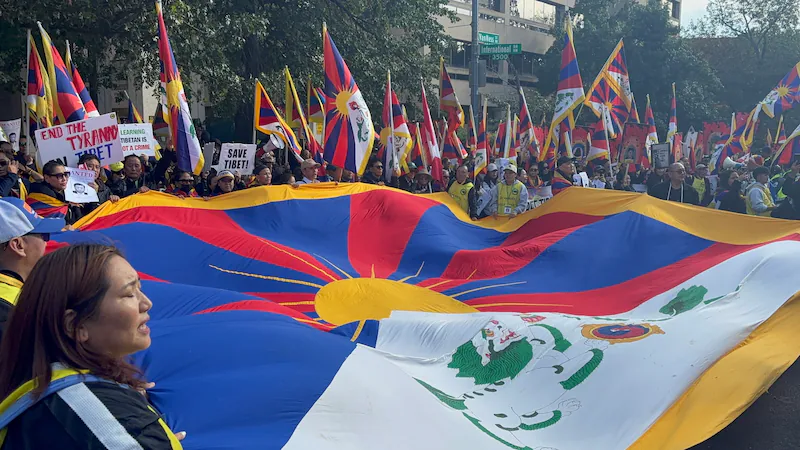
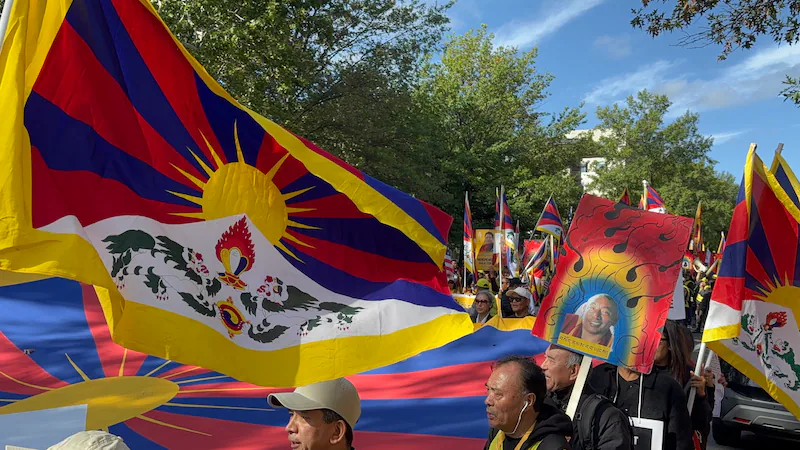
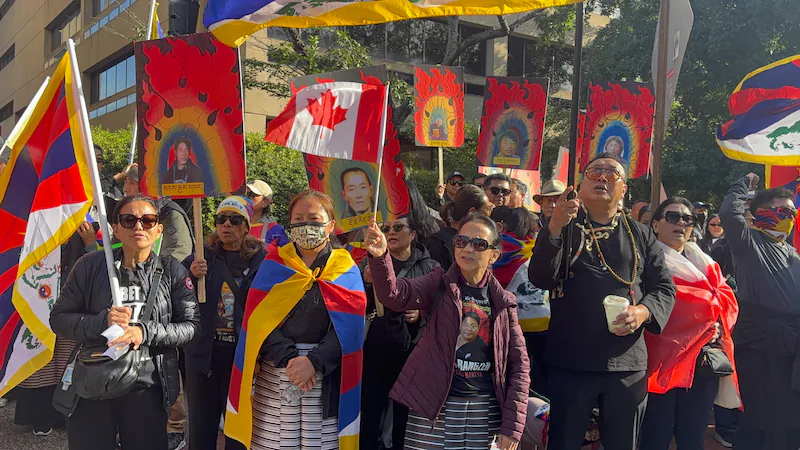
During the same week, the official United States and China arranged a State visit and meeting with Xi Jinping; On the other side, Tibetans, Uighurs, Hong Kong and Chinese democracy activists gathered in the White House, around the Embassy, and in the direction of the National Assembly. Radio Free Asia filmed the flag and rally of Tibetans near the Embassy on 24 September and reported on the address of former Speaker of the House of Representatives Nancy Pellosi to demonstrators near the Congress. These photos of the day-day rallies were not the same moment as the Embassy's late night projection, but showed different political expressions in public space on the day.
原始来源 · rfa.org自由亚洲电台:9月24日华盛顿使馆周边示威图集RFA记者拍摄的白天示威实景,可与深夜事件区分观看。rfa.org ↗On the afternoon of 24 September, in addition to the National Asian Art Museum in the United States, there was a physical conflict between protest participants and men in the welcome crowd. The King King, who was interviewed for the age of the year, said that he had been hit by an umbrella and by pepper spray, and that the ambulance personnel had subsequently been ill-treated; Another participant, Zohang Zifu, claimed that he was under siege. The video and follow-up report from " Look at China " on 28 September pushed images of umbrellas, masks and people blocking into public view. These are clashes that occurred at another location and should not be linked to the 25-morning incident outside the Embassy.
原始来源 · m.secretchina.com看中国9月28日:访美期间使馆外及博物馆外冲突追踪整理两个不同地点的视频与当事人说法。m.secretchina.com ↗03 Inside the diplomatic service and outside the public street
With regard to the protests around the Embassy, there is a constitutional jurisprudence that is directly relevant in the United States. *Boos v. Barry*, a dispute that arose in Washington, D.C., about a ban on displaying slogans that expose foreign Governments to negative evaluation in the vicinity of foreign embassies. The court found that the prohibition of display of the expression violated the protection of the First Amendment. This means that the presence of an embassy does not automatically transform the perimeter public pedestrians into areas where foreign Governments can decide whether objections can be raised. Public order, access and security are still properly regulated, but the view is not a reason to deprive peaceful expression of its liking.
原始来源 · law.cornell.edu美国最高法院 Boos v. Barry (1988) 原判例外国使馆附近公共论坛、言论与集会保护的法律依据。law.cornell.edu ↗Another system relevant to the case is what the United States Department of Justice calls “transnational repression”: foreign governments, directly or through others, threaten, harass, intimidate or harm dissidents and exiled communities outside the country. The definition provides a framework for observing such political conflicts abroad, but evidence of the perpetrator ' s relationship with the commission remains to be found in specific cases to be of this nature. In particular, reports from Yuan Zaigang and others have made these issues more specific: who is involved in the conflict, how can the operation be coordinated, and how can the police record injuries and financial damage?
原始来源 · justice.gov美国司法部:跨国镇压的定义与调查范围美国司法部国家安全部门对外国政府在境外威胁与骚扰异议者的制度性说明。justice.gov ↗04 The report should not be closed after the police arrive
The most easy thing to spread is a second of push and fall. The problem left to the public is behind the camera. Medical records of the wounded, photographs of damage to vehicles, complete video from different angles, surveillance of the incident's route, alarm and alert records determine whether the personal statements made in the news can be translated into a chain of events for which accountability can be sought. Informational information is also of interest to embassy parties, security contractors involved and local police in Washington.
The public media coverage of the event as of 28 September has resulted in at least three sets of materials that can be read in parallel:
- Live video and protesters: Apollo News presented a video of the conflict outside the Embassy, recording Yuan Zaig's own statement on abdominal injuries and damage to car windows;
- JanJA interview with participants like Yuan Zaigang and Guangzhou, 26 September, to restore conflict outside the Embassy and the Museum, respectively;
- Signatures: Radio Free Asia, 24 September, photo coverage of daytime rallies near the Embassy, 28 September, " Look at China " continued to report nighttime images and related questions.
A peaceful protest against visiting foreign leaders should not be based on competing political groups deciding who can stay on the street because of opposition slogans on the ground. The road outside the Embassy in the early hours of 25 September left behind not only political slogans, but also records of injuries, damage to objects and police intervention. They deserve to be preserved in their entirety and to be given the results of a specific event.
Article discussion
Verified members can discuss this report publicly and manage their own content.
Checking member sign-in status…