
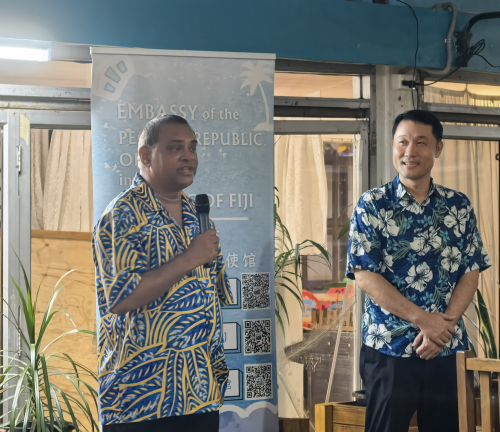
In Fiji, China ' s influence on the media has not been limited to the establishment of a Sino-China office or the organization of communication events, but has entered into a specific editorial section. Reporter without Borders (RSF) published a survey on 21 September stating that Beijing has expanded its presence in the South Pacific media through training of journalists, equipment assistance, travel to China, content exchange and diplomatic negotiations; More notably, some interactions have directly affected the conditions of interviews and political terminology.
原始来源 · rsf.orgRSF:Fiji: A growing institutionalised Chinese media presencersf.org ↗
China ' s local dissemination base has been in operation for many years. Xinhua has been in Fiji since 2011, and China Central Television, CGTN and the diplomatic service have since expanded regional cooperation. In 2025, 11 Pacific island countries and China agreed to strengthen media exchanges; In Fiji, cooperation has further extended to staff training, digital media, social platform management and technical equipment. These resources are highly attractive for small island media with limited commercial revenues.
The problem is that resources do not always remain at the resource level. RSF quoted Kalafi Moala, President of the Pacific Islands Press Association, who stated that the Chinese Embassy had challenged the use of “nation” in its media at least three times to describe Taiwan; The media later changed to “entity”. Whether Moala himself wishes to call it “intervention”, it is clear that the continued intervention of foreign embassies has ultimately changed the political jargon of the press.
More directly, the case occurred during the visit of Wang Yi to the Pacific Islands in
- RSF previously documented that Fiji journalist Lice Movono and photographers were denied accreditation to visit Wang Yi when they tried to do so, and local journalists were unable to ask questions normally. The event took place in Fiji, but was arranged by Chinese-led interviews. Security during diplomatic visits can have borders, but when foreign Governments can decide who can ask questions and whose interview documents are valid in the host country, the influence has crossed public diplomacy and touched on local press freedom.
Public information from the Chinese Ministry of Foreign Affairs and Embassy in Fiji indicates and China has a standing invitation to Fiji Times, Fiji Sun, FBC, Fji Local media such as TV participated in briefings, networking and policy statements. The official narratives emphasize friendly cooperation and mutual understanding, but when the same country provides equipment, training, travel, content and an opinion on editorial terms, the relationship between the media and the financiers is no longer reciprocal.
The Fiji Media Association had stressed the practical value of working with China and believed that editorial decisions remained in the hands of local media. Such statements are worth recording, but the real test of independence is not whether the media is claiming autonomy verbally, but whether it is free to criticize the sponsors after accepting resources, refuse to designate narratives, and maintain its own terminology and standards of interview on sensitive topics such as Taiwan, Xinjiang, and China’s police.
RSF cited a senior journalist from Fiji who stated that media contacts in China are more explicit than traditional partners and may create expectations of “more positive content and less criticism”. Such expectations may not necessarily be included in cooperation agreements, but may be slowly translated into self-restraint through resource dependence, continued relations and diplomatic negotiations. When influence is most effective, it is often not necessary to issue a direct strike order.
The Fiji case thus provides a visible chain of influence: the basis for official media presence, the network of relations between embassies and Governments in cooperation, the resource dependence on training and equipment, the diplomatic access control interview portal, and the entry of the Taiwan designation into the editorial decision. Each ring can be described as normal communication alone, but when they overlap over time, they constitute a national communications system capable of changing the local news environment.
The South Pacific media, which is small and limited in scope, is also more vulnerable to major country input. The real way to protect the independence of the press is not to reject all cooperation, but to make all financial, equipment, travel, sources of content and diplomatic demands public, so that readers know what external power lies behind a news story. Otherwise, “communication” could become a softer word to cover the gradual entry of State authority into editorial space.
Article discussion
Verified members can discuss this report publicly and manage their own content.
Checking member sign-in status…