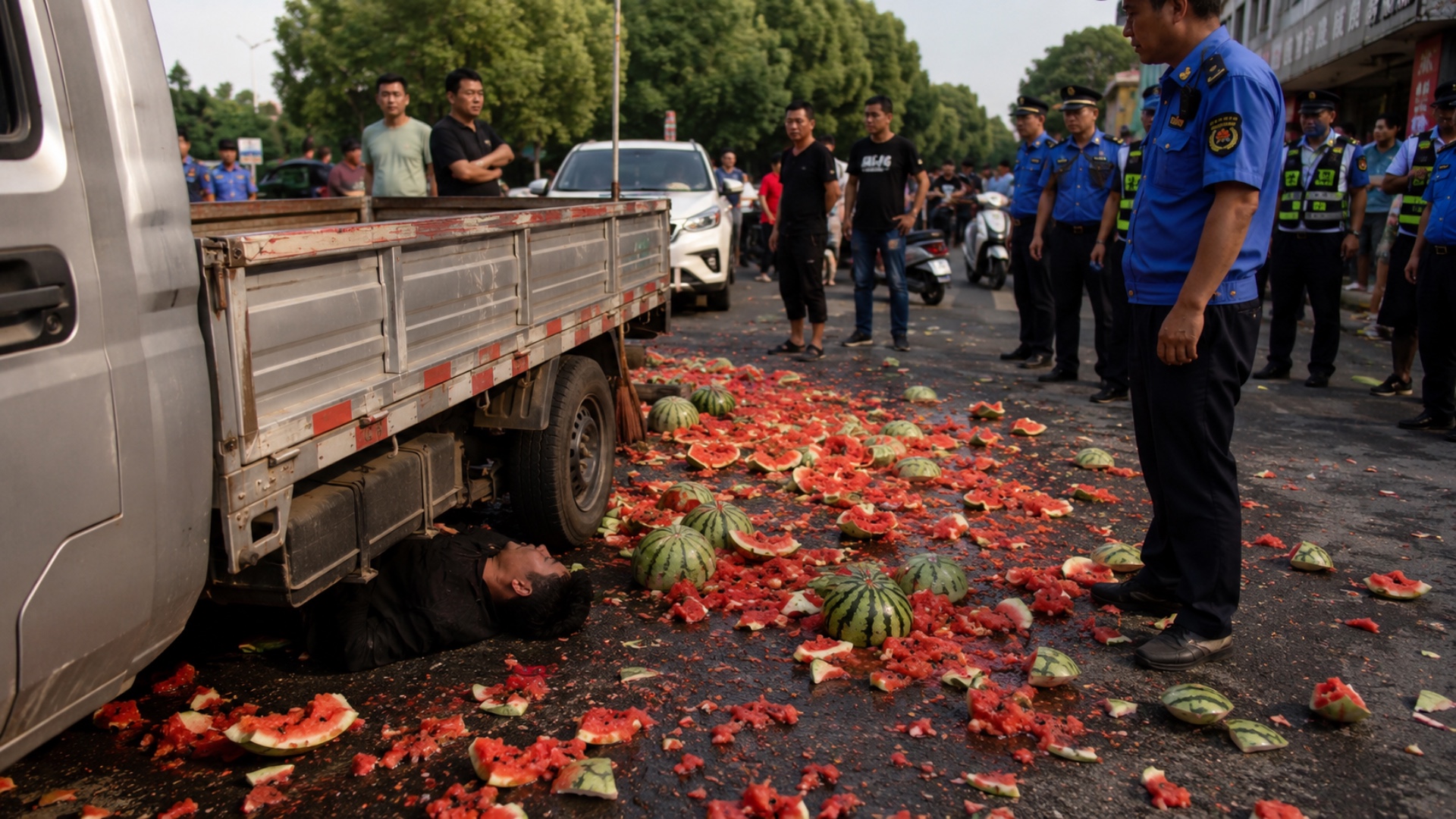
On July 28, Jiangsu Nanjing, along a busy road, red grapefruit and blue-skinned debris scattered over the cement ground. More than this land-filled wave, the eye was closely attached to the ground, most of the bodies did not enter the bottom of the truck.
This is not an accidental street dispute, but a micro-tyranny that occurs every day under totalitarian regimes.
In official propaganda speeches, such incidents are often lightly depicted as “violations” or “quality issues of individual law enforcement personnel”.But this crushed cabbage and the humiliating body lying underneath the chariot just tear off the real face of the time when the CCP authoritarian regime extended to the bottom of society.
The nature of functions: from “administrative management” to “institutional struggle”
A lot of people are accustomed to describing the barbaric enforcement of the city as “bandial acts,” but this wipes out a layer of more cruel nature—bandial wealth is still discussed, and “legitimate violence” authorized by authoritarian state machinery is far more destructive than bandial.

In the logic of totalitarian rule, the city interface is endowed with a political metaphor: from the evaluation of “civilized cities” to the indicators of the order from above down, they are the windows of the rulers showing control. The city management is the “administrative beat” that this system nurtures in order to maintain superficial order.
They do not have to replace the local voters, they only need to be responsible for the indicators of power from above down. When public power is not restricted by democracy and independent justice is completely absent, law enforcement with uniforms and administrative punishment power must show the very plundering and violent bureaucratic bandits style. The crumbs of the ground are essentially the brutal deprivation of citizens' legitimate property and the right to survival.
Desperate Resistance: The System Tragedy of the Weak
Faced with the vast and irresistible machinery of violence, the low-level people who lack freedom of speech and assembly, and no legitimate channels for defence, are in a state of absolute powerlessness.
The video shows a tragic struggle with Chinese grassroots characteristics, when the laws no longer provide shelter, when the system blocks all institutional relief pipes, the underlying individuals can only use their bodies as the ultimate code. This almost self-disappointed resistance attempts to use the bottom line of "human life" to gain sympathy from the peripherals, or temporarily contain the power's crackdown.
This is a tragedy characteristic of a highly authoritarian society: the totalitarian regime is forcing the most vulnerable groups to choose between the “outside” and the “struggle for death.”
The End of Lying
The cold eyes and silence of the spectators of the scene constitute another secret and profound dimension in this picture. It shows that today, when public trust is completely bankrupt, people have long ceased to trust the legitimacy of official law enforcement. The great narrative of the Chinese government continues to advocate the so-called "growth" and "development", while the reality of street violence and struggle is intertwined, but like a surgical knife, relentlessly cut off the real suffering of the subsistence of the bottom layers of authoritarian rule.
A dictatorship that unlimitedly concentrates power and puts people's livelihoods under its feet will inevitably create a blood-wearing confrontation with the people in the process ofining its "surface order".
Not only are the grapes crushed in the streets of South Korea, but also the debris of the regime’s lies of legitimacy.As long as the fundamental structures of totalitarianism are not broken, the looting and struggle on the streets will never stop.
Article discussion
Verified members can discuss this report publicly and manage their own content.
Checking member sign-in status…