First, look at what the decision solves.
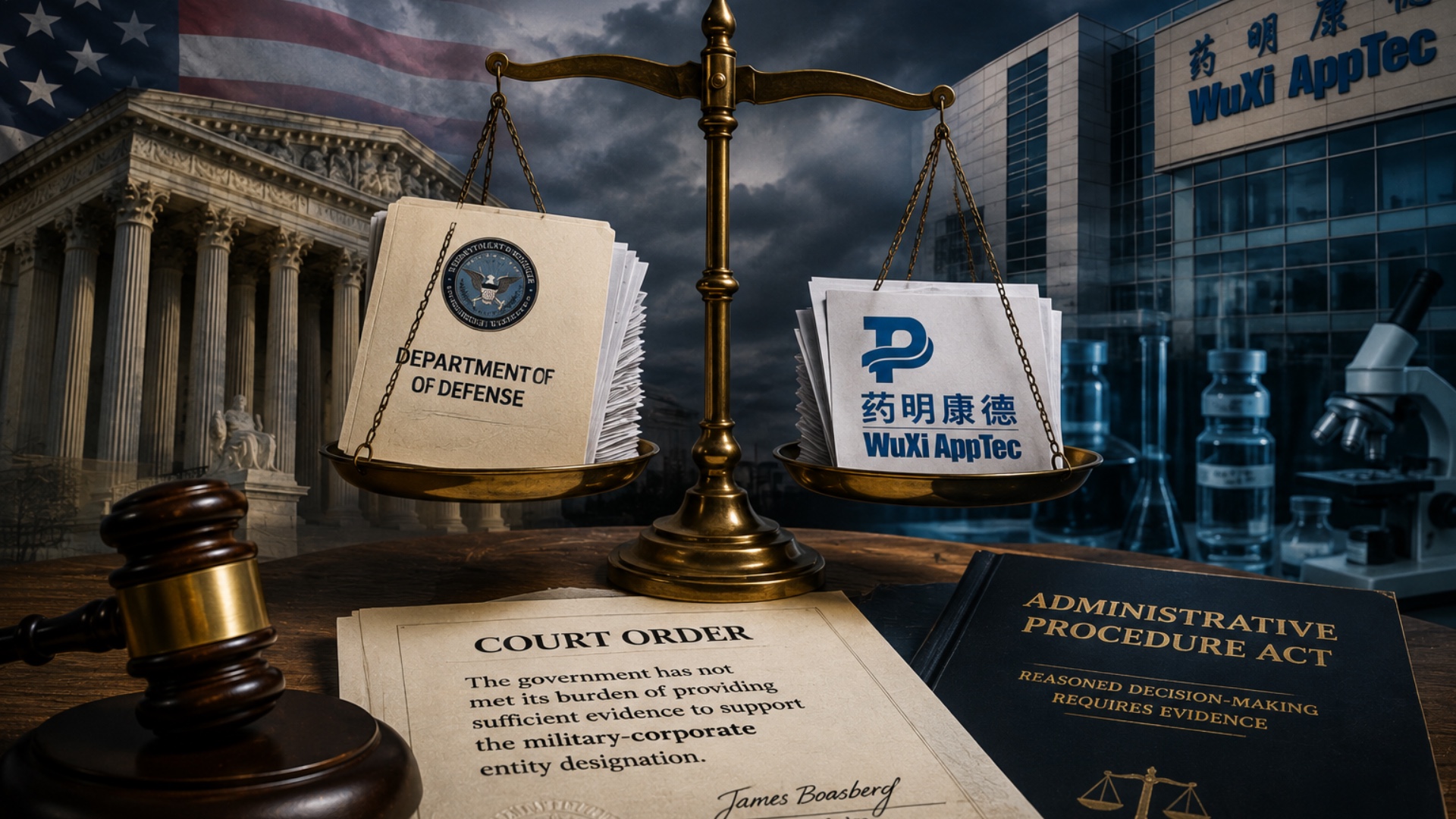
On August 7, U.S. Federal District Judge James Bosberg prevented the U.S. Department of Defense from enforcing the decision to include China’s biotech enterprise Pharmaceuticals Cant on the so-called “Chinese military-industrial enterprises” list.
This means that the court hasn’t denied the U.S. authority to investigate China’s military-civil integration, nor has it denied the U.S. authority to investigate China’s military-civil integration. The judge deals with more basic questions in administrative law—whether the government can prove why it does so when it makes a decision that seriously damages the business interests of a company.
Let’s see what the consequences of this list are.
In June this year, the U.S. Department of Defense expanded the list to cover 188 companies. Chinese companies such as Alibaba, Baidu, Biady, Ozil and others were also included. Entering the list is not equivalent to being subject to comprehensive economic sanctions in the traditional sense, but U.S. government procurement restrictions have begun to take effect and will further restrict the procurement of related enterprise products through third parties in 2027.
For Dr. Kant, this is not a symbolic label.
The company told the court that the relevant findings had caused actual business consequences such as customer cancellation of contracts and damaged supplier relationships. Reuters that Pharmaceutical Canada has more than 4,000 medical and life sciences customers worldwide, of which about 1,200 are based in the United States, and U.S. customers contribute about 70% of its revenue.
Therefore, the third question of the court’s review is the proportion and procedure.
The government has the power of national security judgment, which does not mean that the four words "national security" can replace evidence.The more administrative decisions that can have a significant impact on corporate property rights and business rights, the more need to explain the basis of facts, legal standards and the relationship between facts and conclusions.
Bosberg’s decision was just here to step down the brake.
In recent years, China has also been expanding its national security legal system, the National Security Law, the Anti-Espionage Law, the Data Security Law, and the Criminal Crimes against the National Security in the Criminal Law together form a growing network of administrative and criminal power.
The difference lies in the extent to which the Chinese courts are able to conduct independent substantive review in the face of the decisions of the national security agencies.
In China's cases involving national security, trial is not open, lawyer meetings and consultations are limited, evidence is not disclosed to the public for the sake of state secrets, etc. The CPC Central Committee for Political Law is also in the party's political leadership system above courts, prosecutors, public security and the national security system.
The case of Dr. Kant is therefore worthy of reporting that it is not so simple for a Chinese company to “win the trial” in the United States.
The real meaning of the rule of law is that even if the U.S. government defines a question as a national security issue, the courts can still ask the executive to answer—where is the evidence?
When the executive cannot answer, the judge may temporarily suspend the government’s decision.

National security, of course, requires legal empowerment.But the really difficult part of the modern rule of law is never giving government power, but when the government says “for the sake of national security,” someone still has the right to demand it to draw evidence.
Article discussion
Verified members can discuss this report publicly and manage their own content.
Checking member sign-in status…