

In Guangdong, Qingdao, Qingdao, Qingdao, Qingdao, Qingdao, Qingdao, Qingdao, Qingdao, Qingdao, Qingdao, Qingdao, Qingdao, Qingdao, Qingdao, Qingdao, Qingdao, Qingdao, Qingdao, Qingdao, Qingdao, Qingdao, Qingdao, Qingdao, Qingdao, Qingdao, Qingdao, Qingdao, Qingdao, Qingdao, Qingdao, Qingdao, Qingdao, Qingdao, Qingdao, Qingdao, Qingdao, Qingdao, Qingdao, Qingda
Public on-site material shows that the controversy occurred in Zhivong Town Village. Villagers objected to the demolition operation and gathered on the scene to prevent the construction. This kind of conflict has been repeated in different parts of China not only because of the "non-demolition", but the long-standing imbalance of power between information disclosure, compensation negotiations, complaint channels and enforcement in the process of land and housing disposal.
30 seconds in the camera, closer to reality than many grassroots governance propaganda
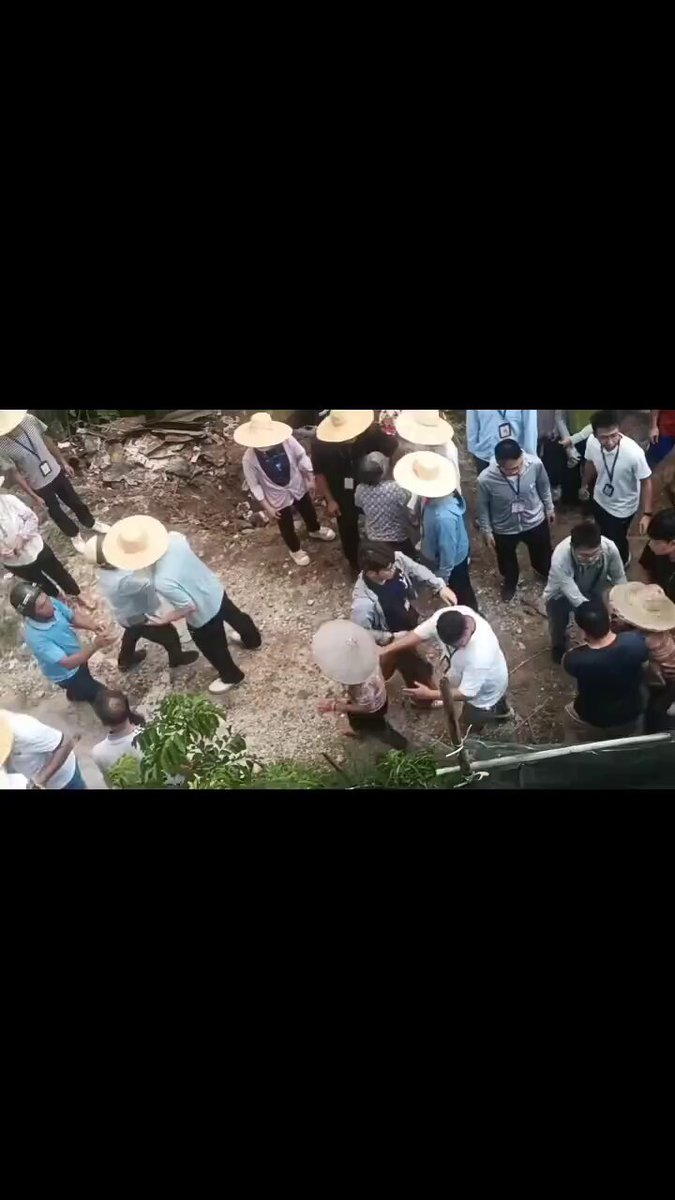
The video cannot replace complete land and administrative documents, but it records the most important facts of the scene: the demolition operation has entered the living space of residents, and opponents must stop the action from continuing in a way that is physically present.
When a system only really hears the residents say “no” after the bulldozer arrives, so-called grassroots negotiations are half failed.
Why is the conflict always going to the scene?
The local government of China is in charge of planning, land management, administrative enforcement and a large number of public resources. In the face of specific residents, the two sides are not equal negotiators. If the residents do not agree to dispose of the plan, they need to find the legal basis, submit applications, review, lawsuits and complaints; the administrative organs have the executive agency, personnel and time advantage.
This power gap is usually widened through several links:
- High costs for residents to obtain complete planning and disposal documents;
- Disputes between compensation standards and the actual value of assets are likely to arise;
- Administrative reconsideration and litigation cycles may be longer than the actual progress of construction;
- Grassroots governments both promote the project and assume partial coordination and enforcement functions;
- Once construction is initiated, residents will find it difficult to restore the building and living conditions that have been demolished even after recovery.
Therefore, many of the real power nodes in the controversy are not the court ruling, but “when the machine comes into play.”
Why the Communist Party of China calls “grass-roots governance modernization” and often stops in front of disobedients
In recent years, Beijing has been constantly promoting grass-roots governance, conflict resolution and law-based administration.But when these slogans are really tested, it is never a time when there is no controversy, but when residents clearly reject the government program.
If the prerequisite for consultation is that residents must eventually accept the established outcome, then such consultation is essentially a procedure for interpreting an administrative decision, not a negotiation that can change the outcome.
Therefore, Wu’s scene is typical: villagers don’t have huge political resources, nor are they discussing national policies, they are fighting for the most concrete interests of life – houses, land, and whether to accept demolition.
Why legal resources are always asymmetrical from "decommissioning according to law" to "defending rights according to law"
Grassroots forced demolition is often accompanied by a large number of legal terms: planning, illegal construction, land nature, administrative decisions, deadline demolition.But for residents, the law is not a sentence "dealing according to law" ends, but should mean being able to see the basis of the decision, obtain the opportunity to defend the statement, apply for remedies, and avoid causing irreversible losses when the dispute is not resolved.
Really worth asking at least includes:
What are the specific administrative decisions on which the demolition is based;
- whether the property and planning documents involving houses or land are fully disclosed;
- whether the residents have received sufficient statements, defences and remedies;
- whether the relevant administrative procedures have been completed at the time of construction;
- if there is compensation, how the standards are formed and whether the residents actually agree.
These questions determine whether a demolition is actually administrative according to law, or whether the administrative organ first uses force to make the facts, and then let the residents prove themselves to be infringed.
“Anti-Communism is not an abstract slogan, it first and foremost means that opposition to power can enter a person’s home without a real consent.”
The CPC political propaganda practice puts “stability” above grassroots conflict, and sees group gathering itself as a problem of governance.But from a resident perspective, the real cause of instability is often not a protest, but a boundary where the lack of power can be effectively rejected and constrained.
If a villager has to stand in front of the construction machinery in order to make their opinions weigh, then the normal channels of expression provided by the system obviously do not play a role.
The 30-second video of Wu Guo Guo is just a slice of China’s vast land and demolition contradiction, but once again exposes the most fundamental paradox of CCP grassroots governance: It continually demands that society obey “lawful governance” but is reluctant to allow ordinary citizens to have legal powers sufficient to restrict executive power.
The real rule of law is not that the government holds the law and requires residents to obey, but that residents also hold the same law and let the government stop.
Article discussion
Verified members can discuss this report publicly and manage their own content.
Checking member sign-in status…