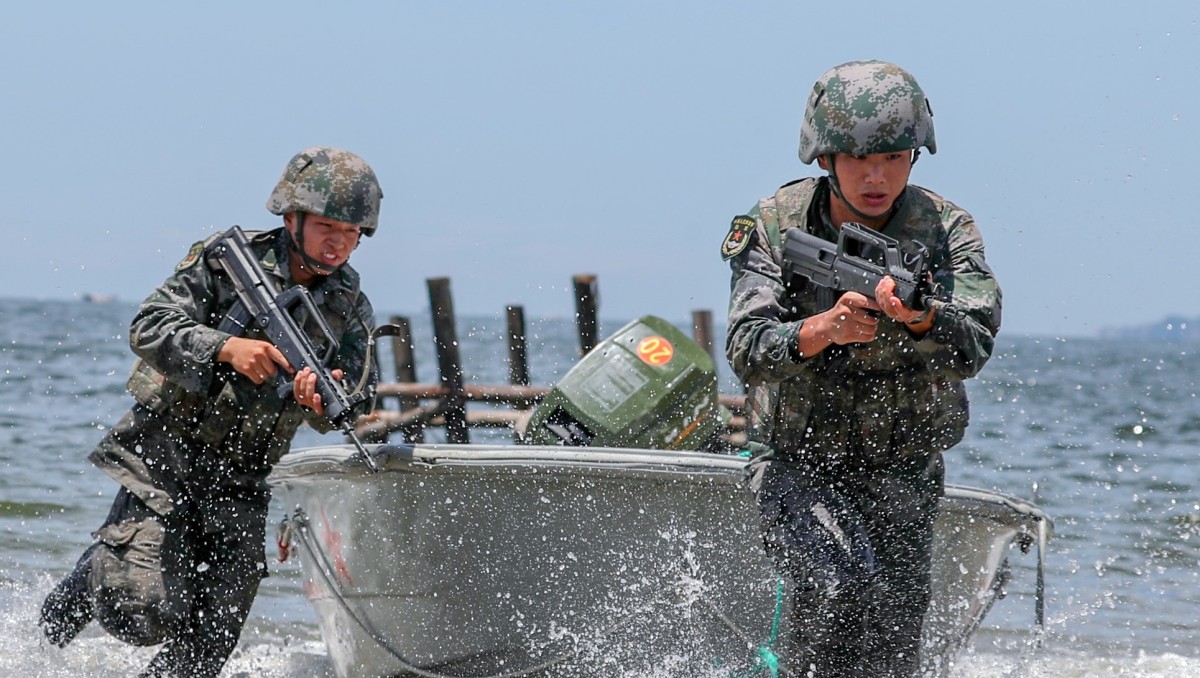
If Taiwan declares independence, 77 per cent of Chinese respondents support military action against Kimmen and Mazu.
However, the question was raised whether there was support for a full-scale attack on Taiwan, which had dropped sharply to about 24 per cent.
These figures are from the latest round of the 2026 China Pulse Survey, conducted by the Carter Center in cooperation with Emory University. Together, they are more worth studying than a single heading of “77 per cent for the use of force”, which reveals a dangerous psychological structure: Many people support war, as long as they believe that it can be contained in a limited range.
原始来源 · taipeitimes.comSurvey shows strong Chinese support for limited attack if Taiwan declares independencetaipeitimes.com ↗The investigation was conducted from 16 April to 26 June and visited 2,500 Chinese interviewees.
The answer is contradictory when different military options are put in parallel
The survey revealed that about 37 per cent of respondents opposed the use of force to unify Taiwan under any circumstances; Some 51 per cent believe that force will only make the cross-Straits problem worse.
At the same time, in the particular context of “Taiwan's formal declaration of independence”, there has been a marked increase in the number of people supporting coercive measures: 77 per cent supported limited military action against Kimmen and Mazu, 59 per cent supported the maritime blockade and 56 per cent supported economic sanctions.
The research team had previously published a survey of attitudes towards the desk, but the link indicated that the time and the results of the study were different from the current one. The charts are historical only and cannot be used as a basis for the figures for this 77 per cent and about 24 per cent.
This suggests that the Chinese public is not simply divided into “battle-in” and “war-back” groups.
Many rejected the full-scale war and accepted what they imagined as “limited punishment”.
The problem is that there is no real war that guarantees no escalation.
(a) Attacks on Kimmen Mazu and the blockade of Taiwan ports, which could be the separate option in the questionnaire; In the real world, they all mean armed conflict.
In the event of casualties, Taiwan's counter-attack, or the intervention of the United States or Japan, the so-called “limited operations” could quickly lose their borders.
Thus, the real danger of this figure is that 77 per cent is not only a rise in nationalism, but rather that a large number of the public may have underestimated the cost of the escalation of military operations.
The Chinese Communist Party has promoted the long-standing creation of a war imagination that “can precisely punish Taiwan”
The public has rarely been fully discussed about the cost of war in official Chinese propaganda.
The military shows missiles, warplanes, landing vessels and interdiction capabilities; The term “responsible” “prosecution” “sword of a united sword” is frequently used by public agents to make military operations look like a policy tool that can be opened and closed at any time.
At the same time, the economic collapse, maritime interruptions, urban casualties, international sanctions and the costs of prolonged occupation that could result from real war rarely have the same spread space.
This does not prove that the answer to each interviewer is a direct result of the publicity, but it constitutes the main information environment in which the public makes risk judgements.
The most alarming is not the “national war fanaticism”, but the illusion of a limited war
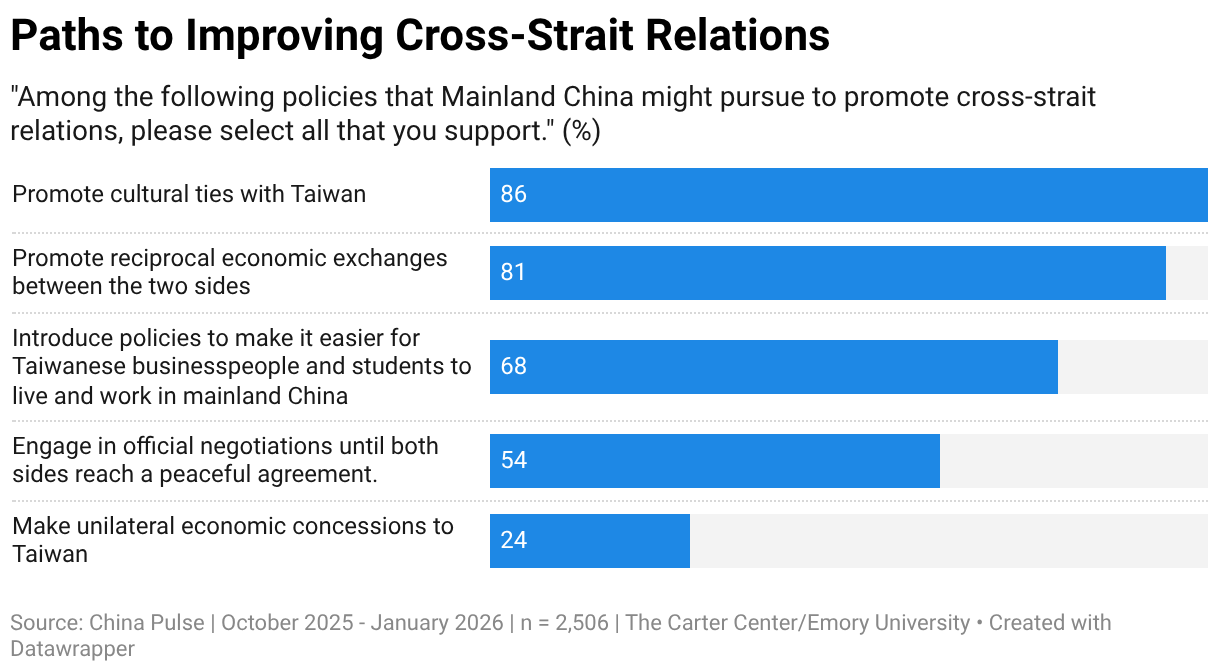
The survey also revealed that Chinese respondents had a high level of interest in Taiwan as a whole, with 83 per cent supporting increased cultural exchanges, 82 per cent supporting trade expansion and about two thirds favouring the peaceful resolution of Taiwan ' s status through formal negotiations.
These figures are in place at the same time as 77 per cent of the support for the attack on Kimmenmazu.
They show that a society can accept the use of force against the outer regions of Taiwan while it likes the Taiwanese and supports exchanges.
This contradiction is the most successful and dangerous part of Xi’s propaganda against Taiwan: cutting the Taiwan people off from the “Taiwan independence” and packaging military operations as a precise punishment for a political label.
Real war will not be so clean.
A missile does not judge the target's support for any political party, and a blockade does not harm “Taiwan independence elements”.
When the public starts to believe that war can be limited, accurate and low-cost, it is often not the enemy, but the war itself, that is truly underestimated.
Do not take the issue of different periods of uncompassionateness as a figure
The current round of media coverage, which used 77 per cent, 59 per cent, 56 per cent and about 24 per cent, corresponded to the responses of respondents to the different policy options set out under the “Taiwan Declaration of Independence” and did not support war in any circumstances by the same proportion of the Chinese population. The other round of China Pulse studies, which was designed using different survey times and problems, could not be replaced directly by these figures. Even if the subject matter of the two surveys is close, if the sample, question presentation or time scenario changes, the difference cannot be attributed to a sudden change in public opinion without analysis. What is really worth reporting is the internal tension within the same investigation: many of the interviewees opposed a full-scale war and were willing to accept blockades or off-island military operations. This is the empirical basis that the “limited war illusion” proposition can build.
Article discussion
Verified members can discuss this report publicly and manage their own content.
Checking member sign-in status…