

China’s 50th Remote Sensor 02 was sent into a rare high retrograde orbit in March this year and disintegrated six months later. The 18th Space Defense Squadron’s orbital data has catalogued at least 43 fragmented targets, spread at an altitude of about 600 to 1,100 kilometers, and continued to run along a retrograde orbit at an inclination of about 142 degrees.
原始来源 · space4peace.orgChinese reconnaissance satellite breaks up in rare retrograde orbitSpaceNews转载资料显示,遥感五十号02星发生解体,美国太空军已编目43个碎片目标。space4peace.org ↗On September 14, U.S. officials revealed that Iran had obtained high-resolution satellite images from Chinese entities in the wake of the July attack on the Mowafak Salti air base in Jordan, which killed three U.S. troops. The investigation also linked the Chinese TEE-01B remote sensing system to the Iranian Revolutionary Guard Air and Space Force.
原始来源 · reuters.comTrump downplays report China entities helped Iran before attack that killed US troops路透社报道美国官员关于中国实体向伊朗提供高分辨率卫星图像的情报判断。reuters.com ↗On the one hand, Chinese satellite capabilities are entering the real war intelligence chain; on the other hand, Chinese reconnaissance satellites themselves are making long-term debris in high orbit.
March launch, September disintegration: Remote Sensor 50 02 star leaves 43 traceable targets
Remote Sensing 5002 was launched on March 15 by Long March 6 A carrier rocket from Taipei Satellite Launch Center. China's official statement of the satellite series' public use focuses on land investigation, crop production estimates and disaster prevention, but external space analysts have long regarded the "Remote Sensing" series as an important part of China's intelligence, surveillance and reconnaissance system, which includes optical, synthetic radar and signal intelligence missions.
On September 4, astrophysicist Jonathan McDowell, based on data from the U.S. Space Force's orbit, noted that Remote Sensing 50's star 02 had already occurred a noticeable fragmentation event. After 43 fragments were categorized, they were scattered at an altitude of about 600 to 1,100 km. This altitude range itself is an important space for large amounts of global remote sensing, communication and military spacecraft activity.

The danger of the debris does not depend on whether they are "large". At orbital speed, even small-sized objects can destroy or seriously injure the satellite. More troublingly, at this altitude, the atmospheric resistance is limited, the debris will not fall naturally quickly and may remain in orbit for decades or even longer.
This means a dismantling of a satellite is not a one-time technical failure, but a long-term risk zone shared by the global spacecraft.
At the same time, Chinese satellite technology has entered the real war intelligence chain in the Middle East.
Another line revealed on September 14 brought the external influence of the Chinese satellite system back from orbit to the ground. U.S. officials said Iran obtained high-resolution satellite images from Chinese entities after attacking the Mowafak Salti air base in Jordan on July
- The attack killed three U.S. soldiers and wounded several.
The Financial Times previous investigation also pointed out that the Iranian Revolutionary Guards Air and Space Force has acquired the ability to use China's TEE-01B remote sensing system.TEE-01B has amy-grade optical imaging capabilities and relies on China's commercial ground station and data service network to operate.
原始来源 · ft.comIran used Chinese spy satellite to target US bases《金融时报》调查中国TEE-01B卫星系统与伊朗革命卫队遥感能力之间的技术链。ft.com ↗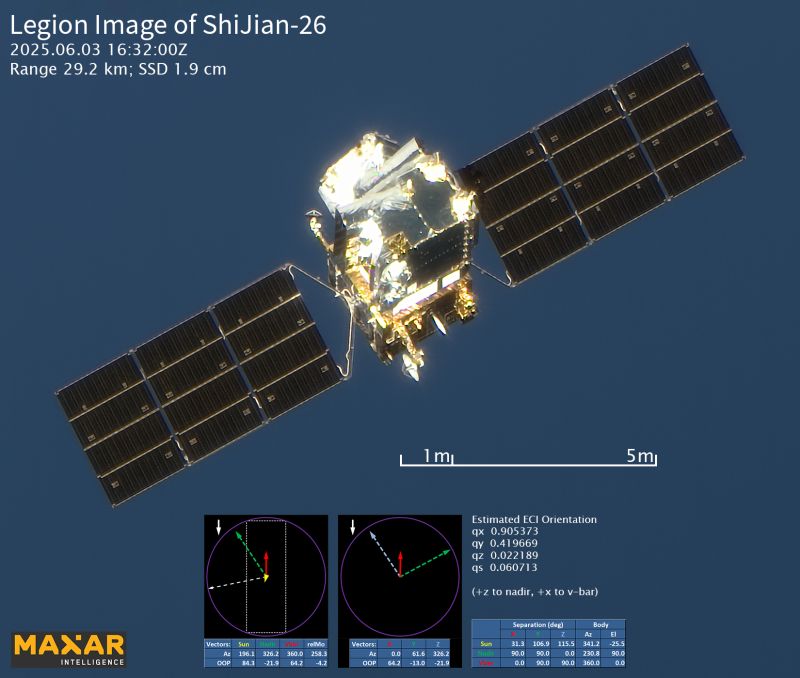
These two clues combined show that China’s space capabilities are far beyond “commercial satellite exports.” High-resolution remote sensing, ground stations, data transmission and satellite operations can be used directly for target identification, pre-attack reconnaissance and war damage assessment once they enter Iran’s military system.
Beijing has long relied on labels such as “commercial”, “civil”, “distance sensing services”, but the battlefield effect will not change because the contract writes “commercial services”.
* Live into a chain of warfare, becoming an orbital burden after failure
Remote Sensing 5002 is not the same satellite as TEE-01B, and there is no evidence that Remote Sensing 5002 is involved in Iranian operations.The real link between the two is that they are part of the same rapidly expanding Chinese military-military dual-use space system: One side seeks more intensive global coverage, higher resolution and faster re-visit capabilities; the other side externalizes the cost of regulating technology reliability, debris management and end-use.
That’s where China’s space strategy is most vigilant.Beijing has gained military reconnaissance, strategic influence, commercial revenue, and the competition of major powers; but the international community can bear two different types of risks: the escalation of war on the ground and the long-term collision risk on orbit.
China's 2007 anti-satellite missile test has left a lot of traceable debris to date. Today, in the context of commercial and military space acceleration, new upper-level fractures, satellite decomposition and high-orbit debris incidents continue to emerge. Each accident alone can be interpreted as a technical failure, but put together shows a marked imbalance between launch speed, military demand and orbital governance.
Space is no longer backward support, but the front-end battlefield in Xi's competitive system of the great powers.
On September 2, Reuters's investigation into the US-China space arms competition revealed that China is developing mobile satellites, pursuit satellites, orbital charging, space jets and technology that can approach or capture other spacecraft.The United States and Britain have also carried out joint orbital operations near suspected Chinese reconnaissance satellites to show Beijing space synergies.
原始来源 · reuters.comUS, China arm for space warfare: hunter satellites and orbital weapons路透社调查中美在机动卫星、空间飞机、轨道追逐与太空作战能力上的竞争。reuters.com ↗China’s military open theory has long regarded “science power” as an important condition for winning modern warfare. The military-civil integration of Xi Jinping’s era has further linked the needs of commercial satellites, university research, state-owned space groups and the Liberation Army.
This also explains why the Iranian case is indicative. When Chinese commercial remote sensing is able to enter the military target chain of a sanctioned regime and China’s own intelligence satellite is producing long-term debris in orbit, the question is no longer whether a single satellite fails, but how the entire expansion model allocates profits and risks.
Xi Jinping’s regime is turning space capabilities into a strategic lever, but does not simultaneously assume transparency responsibilities.
The Communist Party’s greatest political advantage over the space system comes from opacity.Satellite mission uses can be blurred, the boundaries between commercial enterprises and defense systems can be blurred, and data exports and ground station services can also be done through company contracts.At the same time, information that really involves military uses, mission instructions and end-customers is rarely under public supervision.
This structure allows Beijing to simultaneously obtain two narratives: emphasis on “peaceful use of space” and commercial services when international cooperation is needed; and integration of the same technology into the national security system through military-civil integration when strategic capabilities are needed.
The problem is that orbital fragments will not obey the propaganda calibre, nor will battlefield casualties disappear because the service provider is a commercial company.
Remote sensing of the 43 fragmented targets of the Fifty-two star makes one abstract question very concrete: the external cost of China’s space expansion can already be numbered one by one on orbit; while the deaths of three U.S. troops at the Jordanian base write another cost into real war.
From the battlefield to space, the Chinese satellite system is entering a new phase: it is no longer just a demonstration of national power, it is becoming a direct part of international security risks.
Article discussion
Verified members can discuss this report publicly and manage their own content.
Checking member sign-in status…