

On September 4, 2026, an article entitled “The Good of the People’s Commune” appeared.The 4th edition of Liaoning.In the middle of the screen, the "People's Commune is good" five black-body letters are extremely vivid, and the article is decorated with a socialist realism propaganda painting with distinct aesthetic characteristics of the Mao Zedong era: the strong peasants waving farm tools, the masses around the water and water engineering work, cheering, and a whole set of familiar "collective labor, change of land, socialist construction" visual symbols were re-moved back to the public's sight.
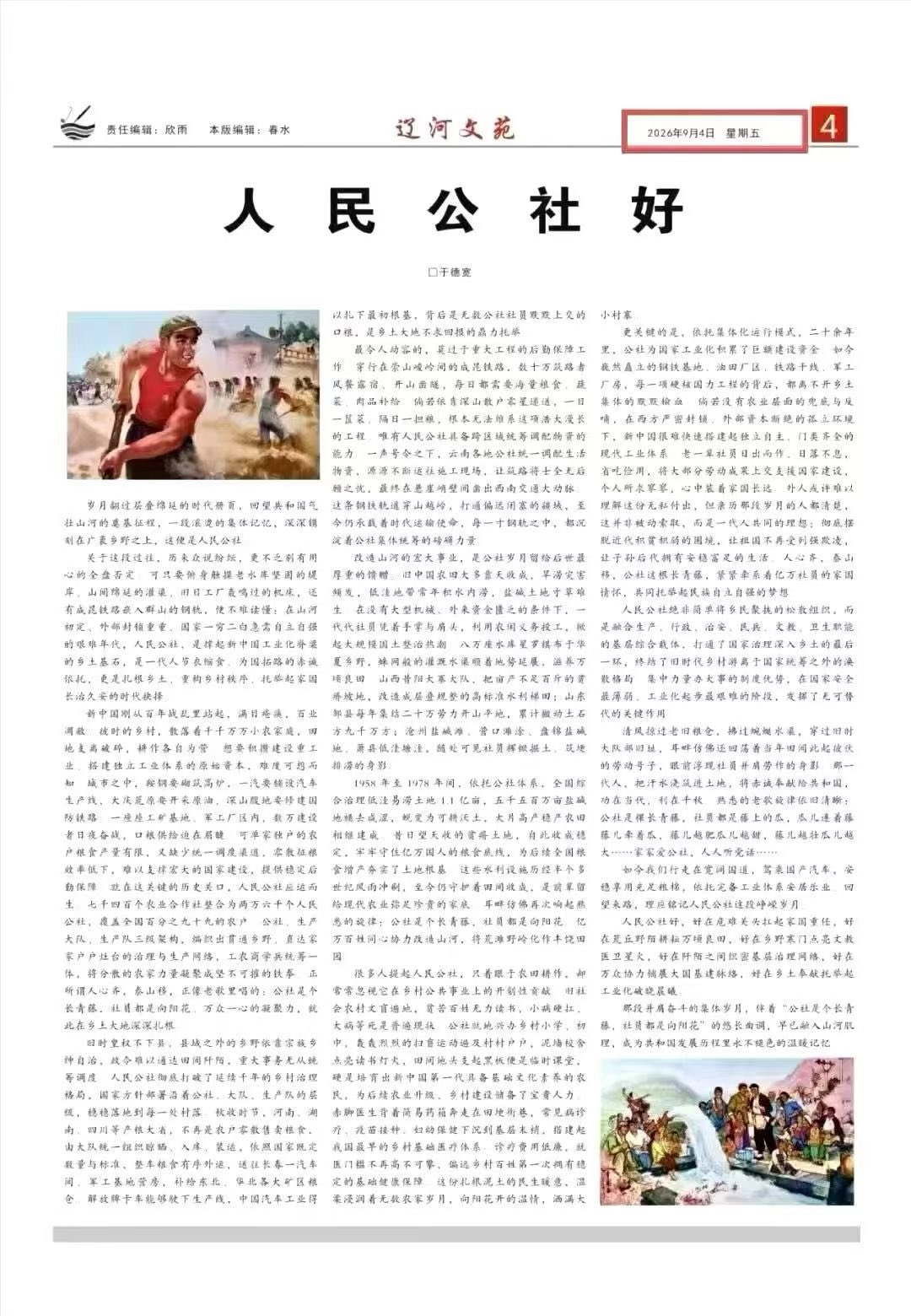
If only an ordinary old man recalled his life in the production team when he was young, this article might not have much political significance. But from the full text, the author is not simply recording personal experiences, but systematically re-evaluating the People's Commune system: the People's Commune, despite its hard life, has completed a lot of water, farmland and infrastructure construction, shaping the collectivist spirit and leaving an important foundation for later rural development. The article was eventually formed not as "I miss the past", but as a more clear conclusion
- that system deserves assurance and even praise.
What really deserves attention is not the phrase "the People's Commune is good", but whether this article chooses what to remember and what to forget in order to come to this conclusion.
The People's Commune was rewritten as a "building history", but the cost of the system disappeared from the narrative.
The description of the period of the People's Commune is highly focused on building achievements. Water reservoirs, channels, agricultural field transformation, collective labor, rural infrastructure and industrialization supports are continuously listed, "Hard struggle", "unity collaboration" and "fighting land" became the core wording throughout the whole article. This writing is easy to give the reader an impression: although the People's Commune era is poor, but the peasant spirit is high, and the country relies on collective forces to complete a large number of engineering construction that is still benefitting today.
The question appears exactly here.
Any serious discussion of the historical narrative of the People's Commune is impossible to bypass a series of institutional disasters that occurred after 1958.People's communalization and the "great leap forward" almost simultaneously, high indicators, floating winds, high grain procurement, public dining halls and grassroots additions together constitute the political and economic environment of that period.Academic researchEstimates of deaths from the Great Famine in China from 1959 to 1961 vary, but all point to massive demographic losses of tens of millions; studies also see rigid food procurement policies, declining agricultural output and institutional failure as important causes of the disaster.
However, in the Good People’s Commune, this whole period of history was almost removed from the narrative. The article retained “hard work” without explaining how much of this hard work came from policy errors; the article retained “struggle” but did not discuss whether farmers had a real choice in a highly administrative production system; the article retained “construction results” without calculating the labor costs, food costs and life costs paid for these projects.
This made the article a historical book of utmost political significance: recording only what the People's Commune left behind, without calculating what the people paid for the system.
“Recovering a lot of reservoirs” is not equivalent to “the superiority of the people’s communist system.”
One of the core arguments for the good of the People's Commune is to prove the value of the system by the large amount of public construction completed during the People's Commune period.This argument appears to have a factual basis, but logically there is a clear leap.
A water supply project built during the period of the People's Commune can only prove that it took place at that historical stage, and it cannot automatically prove that the production organization system of the People's Commune itself is more efficient.
- how it allocates resources and creates labor incentives;
- whether workers have the right to independent choice and withdrawal;
- whether input and output are reasonable;
- whether wrong policies can be detected and corrected in a timely manner after the emergence;
- how the cost of food, labor and life behind the construction results is calculated.
If only statistics of how many reservoirs have been built, how many lands have been harvested, but not statistics of how many farmers have invested in low wages or even unpaid labor; only emphasis on "concentrate forces to do great things", but not asking whether the masses have the right to refuse administrative mobilization; only describing how many assets the collective project eventually left, but not counting the actual living conditions of rural families in the context of food shortages and high purchases, then this system assessment is incomplete from the beginning.
Historical research can acknowledge that the People's Commune period has indeed completed a large amount of infrastructure construction, but acknowledging this fact, there is a whole set of causal relationships that must be proven between the conclusion of "the People's Commune is good" and the article has deliberately or unintentionally omitted the most crucial comparison of institutions in this part.
Behind “collectivism” is hidden whether farmers have the right to withdraw.
The articles repeatedly praised collective labor and mass collaboration, but barely touched on the central institutional question of the People’s Commune: Were the peasants free to choose their own mode of production under that system?
The People's Commune is not an ordinary cooperative.In the highly collectivized rural system, the land and main means of production are collectively controlled, the production team arranges labor, the division of labor and the distribution of income is determined by the collective system, and the urban and rural household system strictly restricts the free movement of the rural population to the city.For an ordinary farmer, the so-called "participation in collective labor" is not a free choice in the sense of modern labor relations.
This distinction is very important.
Voluntary cooperation and administrative organization are not the same; collective mutual assistance and the lack of withdrawal mechanisms are not the same. When a highly organized production system with a clearly administrative compulsory colour is re-described as “the masses unite and work together to build socialism”, the role of state power in it is silently hidden.
So the history of the People's Commune was transformed into a history of morality: no longer discussing whether the system was effective, but only discussing whether the people at the time were hardworking, selfish, and suffering.
If the People’s Commune is really “good,” why should China’s rural reforms end it first?
This is also the most difficult historical paradox to avoid in the Good People’s Commune.
After the reform and opening up, one of the most important institutional changes in China's rural areas was the gradual replacement of the collective production organization in the form of the People's Commune.World Bank Study on China's Rural ReformThe reform of the family responsibility system has dismantled the people's communal production arrangements, contracted agricultural land to families, and promoted the growth of agricultural output and productivity through changes in income rights and incentive mechanisms.
If the People's Commune is really as efficient, reasonable and institutional as it is described in this article, then one of the most basic questions cannot be explained: why is one of the first major institutional changes in Chinese rural areas after reform and opening up to change the mode of production of the People's Commune?
The article is clearly aware of this contradiction, but takes a different approach.It tries to include rural development after reform and opening up in the People's Commune's book of merits, emphasizing that later agricultural modernization and rural construction still build on prior water, land governance and infrastructure accumulation.
This narrative is very clever, because it reinterpreted the reforms, which originally had the obvious institutionally incorrect nature, as the natural link between two successful stages: the People's Commune is responsible for "building the foundations" and the reform and opening up is responsible for "continuing to develop".
Reform no longer means correcting mistakes, but simply “continuing the struggle.”
Propaganda painting is not decorating, but recreating the political memory of the Mao era.
The layout of this article is also worth noting.
If the editorial department would only want to discuss the history of the People's Commune, it would be possible to use historical photographs, agricultural archives, statistics or real production scenes of the year, but the screen was chosen with a strong political propaganda and aesthetic painting: physically strong workers, joyful collective labor, waterworks and the smile of the masses.
This visual language does not assume a historical function, but rather produces emotions.
It quickly reminds readers of a set of political symbols of the Mao era: labor glory, mass power, change of land, collectivism, socialist construction and hard struggle. When the end of the article comes up with the expression of "Community is the Tree, the members are to the Sunflower" with the marked mark of the era, this remembrance is not only a personal emotion, but a reactivation of a particular political culture.
In other words, the article is not about making the reader understand the People's Commune, but about guiding the reader to "feel" the People's Commune.
When facts are discussed to awaken emotions, political propaganda often accomplishes its most effective step.
The background of the party committee propaganda system of the author, making the article more observational value
According to public network informationHe has served in the party committee propaganda, party committee work related positions, and has participated in enterprise culture and social science research activities.The relevant public reports on the specific expression of its history is not completely consistent, so this article only uses this background as a reference to understanding the language style of the article, not as evidence of the editorial intention of the publication.
This identity background is highly aligned with the language style of the article.
The expressions of "hard struggle", "collectivism", "socialist construction", "spiritual wealth" and "foundation for future generations" are in themselves the political language of the long-term formation of the Chinese party government and state-owned enterprise propaganda system.
This means that the Good People's Commune cannot be understood only as an individual's old-fashioned feeling.It is more like an author who has long been in the party committee's propaganda and enterprise culture system, using personal experiences and local building memories, to make a real name for the people's Commune.
Really Surprising: Why This Storyline Will Return in 2026
On the basis of one article alone, it is of course impossible to conclude that the Communist Party of China is preparing to restore the People’s Commune, and there is currently not enough evidence to support this judgment, whether at the institutional level or at the policy level.
But this does not mean that the People's Commune has no political observational value.
For quite a long time after the reform and opening up, China’s officials have retained at least a certain degree of historical correction of the problems arising from the “great leap forward” and the people’s communization process.The People’s Commune eventually withdrew, and it itself constitutes an important sign of rural economic reform.In other words, in the official historical logic of reform and opening up, the People’s Commune at least once belonged to one of the systems that “must be reformed”.
It is worth noting now that the Maoist system and political symbols are being re-evaluated in languages such as “historical experience”, “collectivist spirit”, “grass-roots organizational capabilities”, “hard struggle traditions” and “nation-building foundations”.Whether a systematic policy shift has been formed, it is still to be continuously observed; but when this narrative overlaps with topics such as party organization leadership, food security, grass-roots mobilization and ideological education in recent years, it raises at least one questionable historical memory.
The past reform narrative emphasizes why the old system needs to be changed.
The new political narrative may be more inclined to emphasize that the reform was just as great before it, and that it was even the old systems that laid the foundation for today’s development.
When “correction” is translated into “inheritance”, historical responsibility is of course increasingly difficult to question.
What is really changed is how Chinese people are allowed to remember history.
A Good People’s Commune does not necessarily change history by itself, but it reveals a more cautious question: History does not necessarily need to be modified by public denial.
The most effective method is selective memory.
- Speaking only of the reservoirs, not of hunger;
- speaking only of collective labour, not of the right of the peasants to refuse;
- speaking only of the industrialization of the state, not of the food and the price of rural industrialization;
- speaking only of the "hard struggle", without distinguishing between difficulties arising from natural conditions and disasters arising from political decisions.
For a long time, a generation of young people who have not experienced that era have not seen the People's Commune, it may only remain in the propaganda painting smiles, water channels, red flags and hot fire work to heaven.
True history is not formed in this way.
Any system should be tested for achievements and costs at the same time.The water facilities left behind during the People’s Commune can be discussed, the mobilization capacity of the rural grassroots can be studied, and certain experiences in the collective economy can be analyzed, but these cannot serve as a reason to wipe out the big leap, the big famine, the administrative compulsion and the limitation of farmers’ rights.
If a narrative only allows people to remember the construction of a nation, but does not allow people to remember the cost of this construction; if it allows only the singing of collectives, but does not allow the discussion of whether individuals have the right to choose; if it allows only the praise of historical achievements, but continually removes institutional disasters from the memory, then this writing is no longer just the study of history.
It began to become a rebuilding of political memory.
And this,, is the place where the People's Commune Good in 2026 is truly worth asking:
More than forty years after the people’s communes disappeared, why is it necessary to tell the Chinese again today – “the people’s communes are good”?
Article discussion
Verified members can discuss this report publicly and manage their own content.
Checking member sign-in status…