
The United States Treasury Department moved “Operation Economic Isolation” to a third-country banking system on 28 August. FinCEN, the United States financial crime enforcement network, proposed rules to prohibit United States financial institutions from opening or maintaining correspondent accounts for the United Arab Emirates branch of the Egyptian bank Misr under section 311 of the USA Patriot Act and required United States banks to take measures to prevent foreign correspondent accounts from being used to process transactions involving that branch.
This action is now directly targeted at the Iranian financial network, not at the Chinese banking system. The United States Treasury Department stated that between January 2024 and June 2026, Banque Misr UAE handled approximately $1.8 billion in transactions for 103 companies that might belong to the Iranian Shadow Bank network and described the branch as a significant point in Iran ' s acquisition of the United States dollar. The FinCEN measures are still at the stage of the proposed rules and do not amount to a full assets freeze on the entire Messel Bank Group in Egypt.
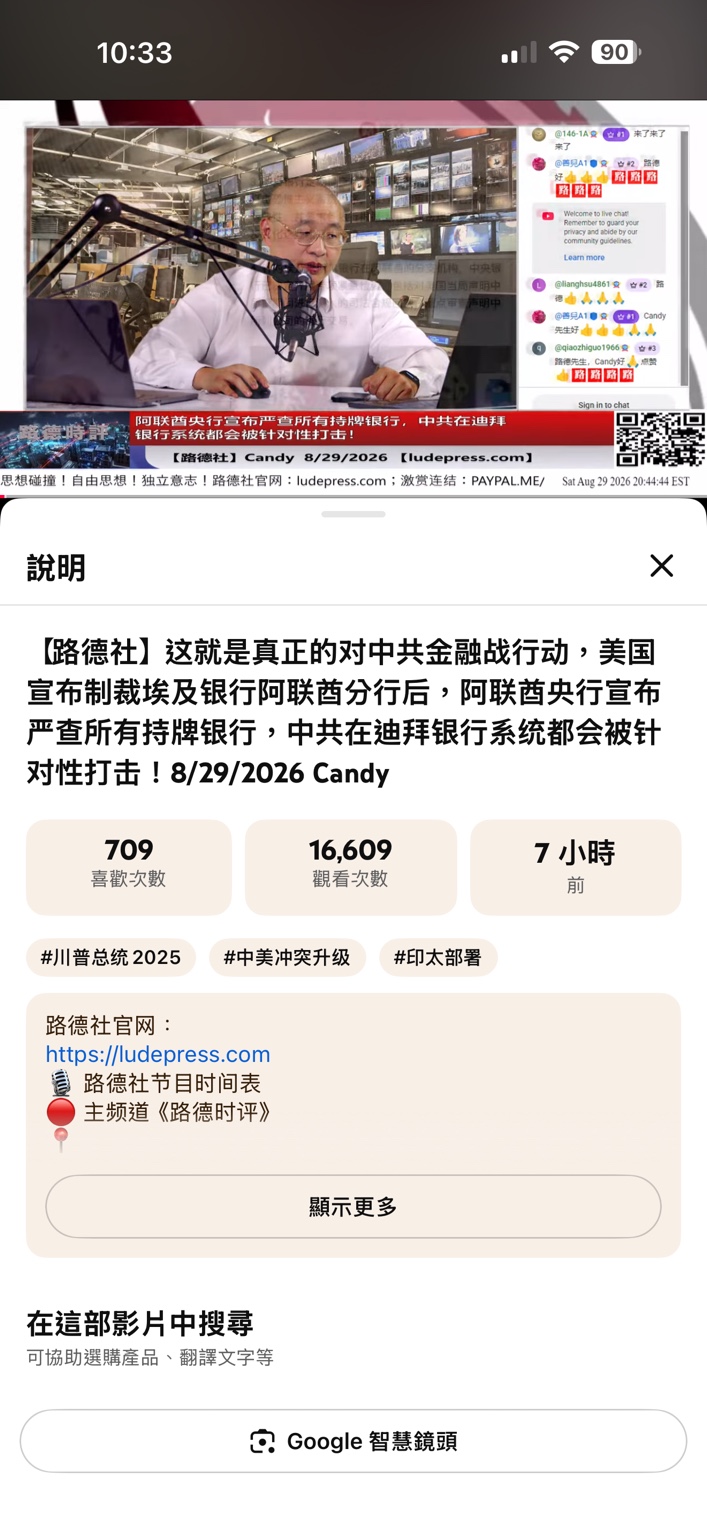
The Lutheran video page interprets the action as “the financial war against the Communist Party”. This is a critical judgement. This paper, which is examined by the US Treasury Department, FinCEN and other open sources, suggests that, more precisely, the US is expanding its enforcement pressure on third-country banks, offshore companies and dollar-based clearing networks, a mechanism that may channel the financial networks of the Communist Party that are close to Iran’s transactions.
But the importance of this case for the CCP-controlled financial and trade networks is not only that there are any large Chinese banks on the list, but that the United States is demonstrating a replicable model of enforcement: it is not necessary to first sanction a sovereign country’s core bank, and that third-country financial institutions can attack directly its ability to enter the US financial system by providing a United States dollar clearing, proxy account, money-laundering, or sanctions evasion service to a sanctioned network.
The United States dollar liquidation risk begins to be channelled to third-country banks
Even if international trade does not take place in the United States, as long as the dollar is liquidated, it often requires the passing of correspondent banks connected to the United States financial system. The power of the FinCEN 311 instrument is here. It could isolate a foreign bank from the United States dollar proxy account network and force other banks to reassess the compliance risks of dealing with the agency.
The United States Treasury Department also explicitly warns in this bulletin that global financial institutions are at higher risk of sanctions because of their exposure to Banque Misr UAE and other Iranian financial facilitators. This means that the actual impact may exceed that of a bank named: international banks, trade finance institutions, payment intermediaries and compliance authorities may take the initiative to expand the scope of the review to avoid being identified as helping sanctioned networks to continue to access United States dollar services.
This “risk spill” is precisely what the Chinese Communist Party (CPM) financial networks need to be vigilant. China is one of the leading buyers of Iranian oil. Reuters reported on 20 August that United States Treasury Secretary Besent had asked Beijing to cooperate in putting pressure on Iran; According to Kpler data, China has purchased more than 80 per cent of Iran ' s sea oil. Meanwhile, on 28 August, the United States Treasury Department sanctioned Kameng Trading Limited, a Hong Kong company, for facilitating the entry of the sanctioned Iranian exchange agencies into the international financial system and their laundering of funds.
Thus, the risk of Hong Kong companies, offshore traders, Dubai brokers and third-country banks joining in the settlement of oil payments, trade financing or sanctions evasion in Iran is being placed in the same web map by United States law enforcement. The key here is not whether the business is registered in China, but whether the money ultimately touches the dollar system, United States banks or the chain of transactions covered by United States sanctions laws.
Pressure on Chinese-owned banks may first be expressed as “excessive compliance”
At this stage, there is no evidence that the United States has decided to take the same measures as Banque Misr UAE against large State-owned banks in China. Indeed, recent public reports indicate that the United States, while tightening Iran ' s sanctions, has avoided the direct imposition of full sanctions on major Chinese financial institutions. This is related to the need for Washington to weigh the financial stability of China and the United States, trade relations and global market shocks.
This does not mean that the Chinese banks are not affected. A more realistic short-term shock may come from a contraction in risk in the compliance sector. As long as the United States Treasury Department continues to name companies and banks in Hong Kong, Dubai, Iran and other jurisdictions, international financial institutions may improve due diligence standards for Chinese clients, Hong Kong trading companies, United Arab Emirates accounts and related payments to Iran.
This change may be reflected in extended payment reviews, requests for information on final beneficiaries, rejection of complex trans-shipments, restrictions on high-risk client agency accounts and suspension of United States dollar transactions that cannot explain the source of funds and trade background. For Chinese enterprises that rely on offshore companies, third-country accounts and multilayered trading structures, the cost of financing and the friction of settlement are likely to rise.
The risks in Hong Kong are particularly interesting.
The United States Treasury Department this time named a Hong Kong company, which brought Hong Kong back into the official documents of Iran ' s sanctions-neglected network. Hong Kong itself was an international financial centre and an important platform for a large number of Chinese enterprises to conduct offshore financing, dollar settlement and cross-border trade.
If the United States moves its future focus on enforcement from individual shell companies to financial institutions that provide accounts, clearing or financing for these companies, the cost of compliance in the Hong Kong banking system involving high-risk trade may continue to increase. For the ability of the CCP to maintain international financing and dollar liquidity through Hong Kong, such progressive pressures, while different from comprehensive financial sanctions, could continue to undermine the availability of grey channels.
Dubai is losing its security stop.
The Central Bank of the United Arab Emirates, following the United States operation, promptly announced that special, urgent and in-depth inspections of Banque Misr's branch office in the United Arab Emirates would be carried out, including forensic rechecks of transactions during the relevant period. It should be noted that the UAE Central Bank has not announced that all licensed banks will be subject to a special investigation at the same time; However, it stressed that all licensed financial institutions must comply with anti-money-laundering, counter-terrorism financing and sanctions screening requirements.
This creates new uncertainty about the Chinese-related network that relies on Dubai as a offshore trade, financial transit and cross-border clearing centre. In the past, Dubai played an important role in connecting China, Iran, Russia, the Middle East and Africa. If the UAE regulatory bodies under pressure from the United States further strengthen bank customer scrutiny, end-beneficiary identification and sanctions screening, some of the high-risk structures that were able to operate locally in the past may be forced to move, split or exit the banking system.
The real test for the United States is "who will pay the dollar for the sanctioned network"
It is not accurate to describe the operation as “the United States has launched a financial war against the Communist Party” as currently evidenced. The United States Government's paper clearly points its targets to the Iranian regime and its financial facilitators, and Banque Misr UAE is also targeted for being designated as the Iranian Shadow Bank network for the processing of funds.
However, from the policy mechanisms, the case does give a clear warning to the Chinese Communist Party about financial activities: the United States can bypass the positive impact on large Chinese banks, starting with the Hong Kong Shell Company, Dubai Brokers, third-country banks and dollar-agent accounts, and increasing the cost of dealing with the sanctioned country on a step-by-step basis.
If the United States Treasury Department can prove that certain Chinese-owned financial institutions knowingly or with knowledge have helped Iran to evade sanctions and have decided to use Article 311, OFAC sanctions or secondary sanctions instruments, the impact will no longer be limited to single Iranian transactions, but may touch on correspondent banking relationships, dollar financing and international reputational risks. This would be a more substantial pressure on the CCP financial network.
The three most valuable signals for the time being are whether the United States is further naming Chinese or Hong Kong financial institutions; (a) Whether the Central Bank of the Emirates ' emergency checks have been extended to other banking and trade financial accounts; The final rules of FinCEN were formally adopted and become a template for subsequent targeting of third-country banks.
Before these signals appear, the precise judgement of the operation should be that the United States has moved the pressure of sanctions from Iranian entities to third-country banks that provide them with financial access and has begun to reach Hong Kong companies. This model has the institutional capacity to spread to the financial networks of the Communist Party, but it is not yet possible to conclude that the United States has carried out a comprehensive financial strike on the Chinese banking system.
Article discussion
Verified members can discuss this report publicly and manage their own content.
Checking member sign-in status…