

On August 9, a clash occurred at the workplace of the Marine Natural Gas and Chemical Complex in Ustyuruga, Leningrad, Russia. A Chinese worker was taken away by the Russian police after a lengthy dispute with the management, and thousands of Chinese workers quickly gathered on the scene, surrounded by police cars and prevented the police from leaving. In the video, workers wearing safety hats, clothes, screams, photographs, and singing the Chinese national anthem were released.
原始来源 · yesterdayprotests.com俄罗斯上千中国工人围堵警车,阻止持枪警察抓人“昨天”记录8月9日乌斯季卢加中国工人围堵警车事件及欠薪背景。yesterdayprotests.com ↗The conflict was not suddenly out of control. Months before the on-site conflict, wage deficits had been accumulated. Li Jing, head of China Labor Observatory, noted that between 2025 and 2026, some workers in the region faced problems such as three to eight months of pay delays, passport seizures and restricted actions. Workers eventually opted for collective circumvention, indicating that routine communication and internal complaints have long lost effect.
原始来源 · cna.com.tw中国工人遭俄警方逮捕 上千人包围声援后获释中央社整理乌斯季卢加工地事件经过及项目背景。cna.com.tw ↗原始来源 · ejinsight.comIn Russia, Chinese workers have privilege to protestEJ Insight援引中国劳工观察负责人说明工资延迟、护照被扣和行动限制等情况。ejinsight.com ↗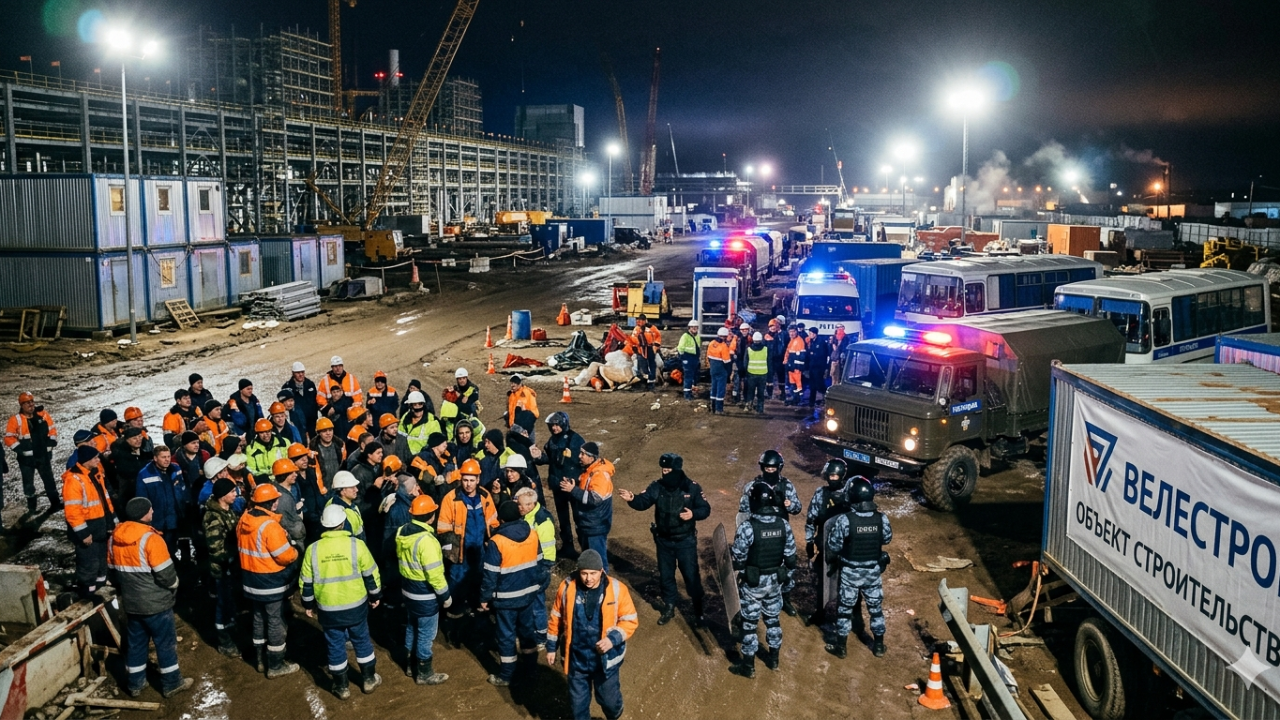
The salary issue has been delayed for a long time before the police car was surrounded
Ustyurka, located near St. Petersburg, is the home of a cluster of important energy and chemical projects in Russia. Not only ordinary labor companies participate in the construction, large Chinese contractors such as China Chemical Engineering Seventh Construction Co., Ltd. appear on the project chain.
In large multinational projects, wages, accommodation, visas, transportation and documents are often controlled by the same management system.Workers are more dependent on their employers after leaving the country.Wages are hard to withdraw from once they are indebted; if passports and accommodation are controlled, labor relations quickly evolve into personal dependence.
The protests of Usdile processors therefore have a very specific institutional background: they are not negotiating with employers on an equal footing in a free labour market, but in a highly closed project management environment, compensating for the lack of organizational power with numbers.
Thousands of people came out to show that there was no organization that could really speak for them.
The official trade union system of China belongs to the General Trade Union of China, and independent trade unions do not exist.The workers do not have the freedom to form organizations, negotiate wages for a long time and decide on strike strategies.
On the Russian project, workers face a double power structure: on the one hand, the Chinese project management and contract chain, and on the other hand, the local police and administrative system. Under normal circumstances, wage disputes should have been handled through trade unions, contracts, arbitration and collective negotiations; in the absence of independent organization, disputes are often pressed to the last moment.
The picture of August 9 illustrates the problem.The moment when workers really gained negotiating power was not in the conference room or in the corporate complaint channel, but after thousands of people surrounded the police car at the same time.
The warmer the national relations, the security of ordinary workers does not rise simultaneously.
Xi Jinping and Putin described China-Russia relations as high-level strategic cooperation, and the two countries continued to deepen cooperation on energy, finance, military, diplomatic and infrastructure projects.
But for workers, the height of state relations does not automatically translate into wage guarantees.Projects can get cross-border funding, construction coordination and political backing, while the lowest working class still faces wages, document control and police intervention.
Both countries belong to a highly concentrated political system of power, national cooperation primarily serves governments, state-owned enterprises and strategic projects, and working individuals find it difficult to gain access to organizational resources independently from the state and the enterprises. So the "strategic partnership" is reflected at the top level as summits, energy contracts and diplomatic synergies, but may only be reflected in the workplace by more complex contractual chains and weaker individual negotiation capabilities.
China-funded enterprises "go out", bringing the domestic labor structure out together
During the Xi Jinping era, Chinese enterprises continued to promote the expansion of state-owned enterprises and engineering contractors overseas.From the Belt and Road to China-Russia energy cooperation, Chinese enterprises continued to enter large-scale infrastructure and industrial projects.Capital, technology and construction capabilities have indeed achieved cross-border exports, but the labor system has not synchronized upgrading.
Domestic subcontracts, closed management, delayed wage settlement and the lack of independent organizational powers of employees are common in overseas, but language, visas, residence and judicial environments add to uncertainty when workers arrive abroad.
This puts Chinese overseas workers in a special situation: they are packed with national narratives as “going out” builders, but lack labor protection that matches this national-level project.
The police car in Ustyuruga explains the classification of the relationship better than any joint statement
On the same day, the workers eventually left their colleagues behind.This resulted from the collective pressure of thousands of people on the scene, rather than the formal labour mechanisms.
This scene exposes the social bottom of the “Chinese-Russian friendship” very bluntly: cooperation between countries can be raised to a strategic height, enterprises can rely on political relations to promote projects, but ordinary workers are still at the end of the power chain.
In terms of the “outside of the Red Wall”, the value of the Uzbek event is not in adding a negative label to China-Russia relations, but in showing how the relationship falls on ordinary people.
Thousands of Chinese workers are surrounded by a Russian police car, which is the most concrete and hard-to-propagate reality of this strategic relationship.
Article discussion
Verified members can discuss this report publicly and manage their own content.
Checking member sign-in status…