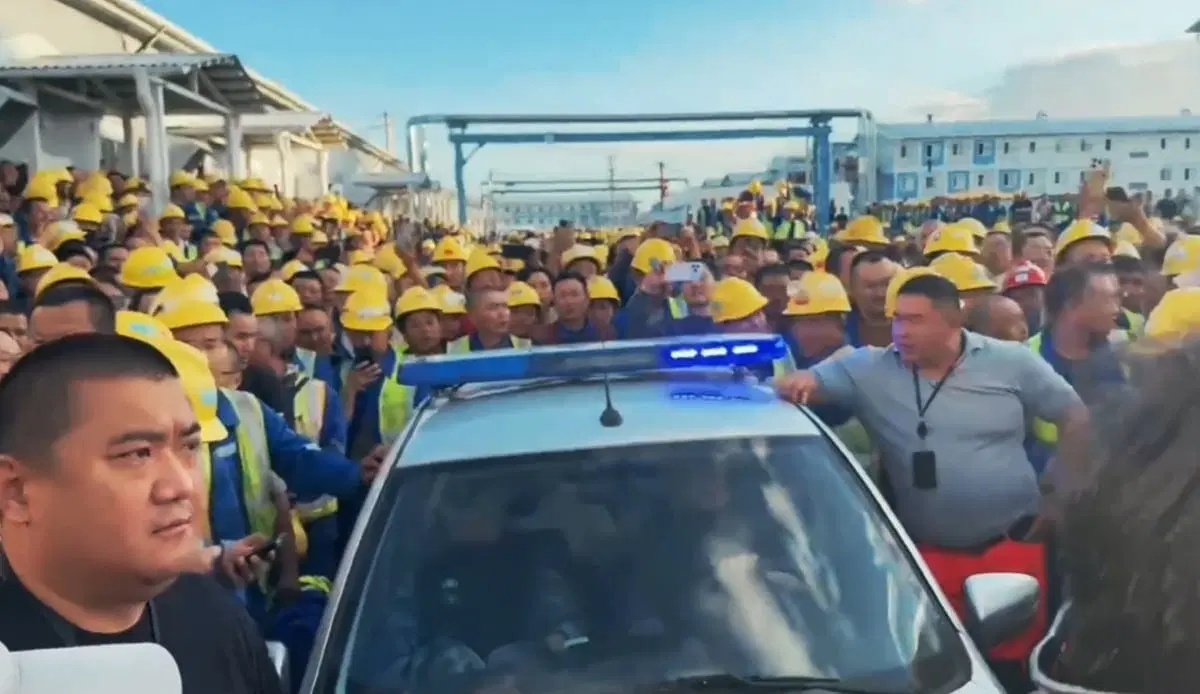
9 August, Ustiluga, Leningrad region, Russia. On the Baltic Gas Chemical Complex, a large number of Chinese workers surrounded a police vehicle. In the public video, the workers were wearing a helmet and a reflecting vest, which did not disperse. The cause was not complicated: a Chinese worker had a dispute with the manager over the payment of wages, the projecter had called the police, the Russian police were going to take the man, the workers were coming up, and eventually the man was left on the scene.
This scene is closer to the real cost of overseas work than any business brochure. A large project with a contract value of RMB 100 billion, with a complex system of cross-border contracting, a conglomerate background and a narrative of energy strategies; But for the bottom-up workers, the final problem remains the original one: whether wages are on time.
The larger the project, the greater the responsibility cannot be diluted by the subcontracting chain
Public information indicates that the contractor in question was directed at China Chemical Engineering Construction Company Limited. Moscow Monitor quoted China Chemical Engineering Group as reporting annually that the contract for the Baltic Chemical Project was in excess of RMB 100 billion. The Business and Human Rights Resource Centre subsequently sent a query to Zhejiang regarding unpaid salaries and on-site clashes, and no response had been received as at 16 September.

The most common way of diluted responsibility for overseas works is to cut the wage layer: the lump sum is the subcontracting of labour, the subcontracting is the non-payment of funds, the intermediary is the contract is otherwise agreed, and the project company emphasizes the settlement cycle. Each level can find its own explanation, and the last to take the risk is the person who has already worked.
The significance of the Ustiluga incident is precisely that workers have broken down this system of decentralization of responsibility with collective action. Workers surrounded police cars, not only to prevent a fellow worker from being taken away, but also to push into public space a wage dispute that had been closed inside the enterprise.
ng ng can't go out with responsibility or even leave the country together
Large Chinese engineering firms have long regarded overseas projects as part of their internationalization capacity and national engineering capabilities. Since enterprises enjoy the advantages of corporate credibility, financing capacity and national resources, labour management cannot be returned to the lowest-level logic of “who is responsible” after leaving the country.
It is not difficult to really clarify the controversy: labour or labour contracts, payment of wages, subcontracting agreements, lists of persons, passport management and project attendance records are sufficient to repay who owes whom, how long is outstanding, and who bears direct responsibility. The question is not whether evidence does not exist, but whether the party that has the authority to manage is willing to spread the chain of responsibility.
Police cars are surrounded, the last scene after industrial relations failed
Workers can push tensions towards collective confrontation only if the normal channels fail to resolve them. The most noteworthy thing on the site in Ustiluga is not how intense the “worker's round-the-street” itself is, but why a trillion-class project has to come to this point to see the wage dispute.
Overseas works can be packaged as cooperation, strategy and growth, but these grand narratives have no meaning for workers when wages are not paid. What really needs to be answered for Seven and its superiors is not the size of the enterprise, but the most fundamental question: why in their own project chain, workers need to block their collective access to the hearing.
Article discussion
Verified members can discuss this report publicly and manage their own content.
Checking member sign-in status…