A list of enterprises is changing the burden of proof on Chinese goods entering the United States market.
The United States added 43 Chinese enterprises to the list of Uighur Forced Labour Prevention Act (UFLPA) entities at the end of July. Under the Act, as long as the goods are produced in whole or in part by Xinjiang or by the listed enterprises, the United States Customs Service assumes in principle that they involve forced labour, the importer must provide sufficient evidence to refute this presumption, otherwise the goods will not enter the United States.
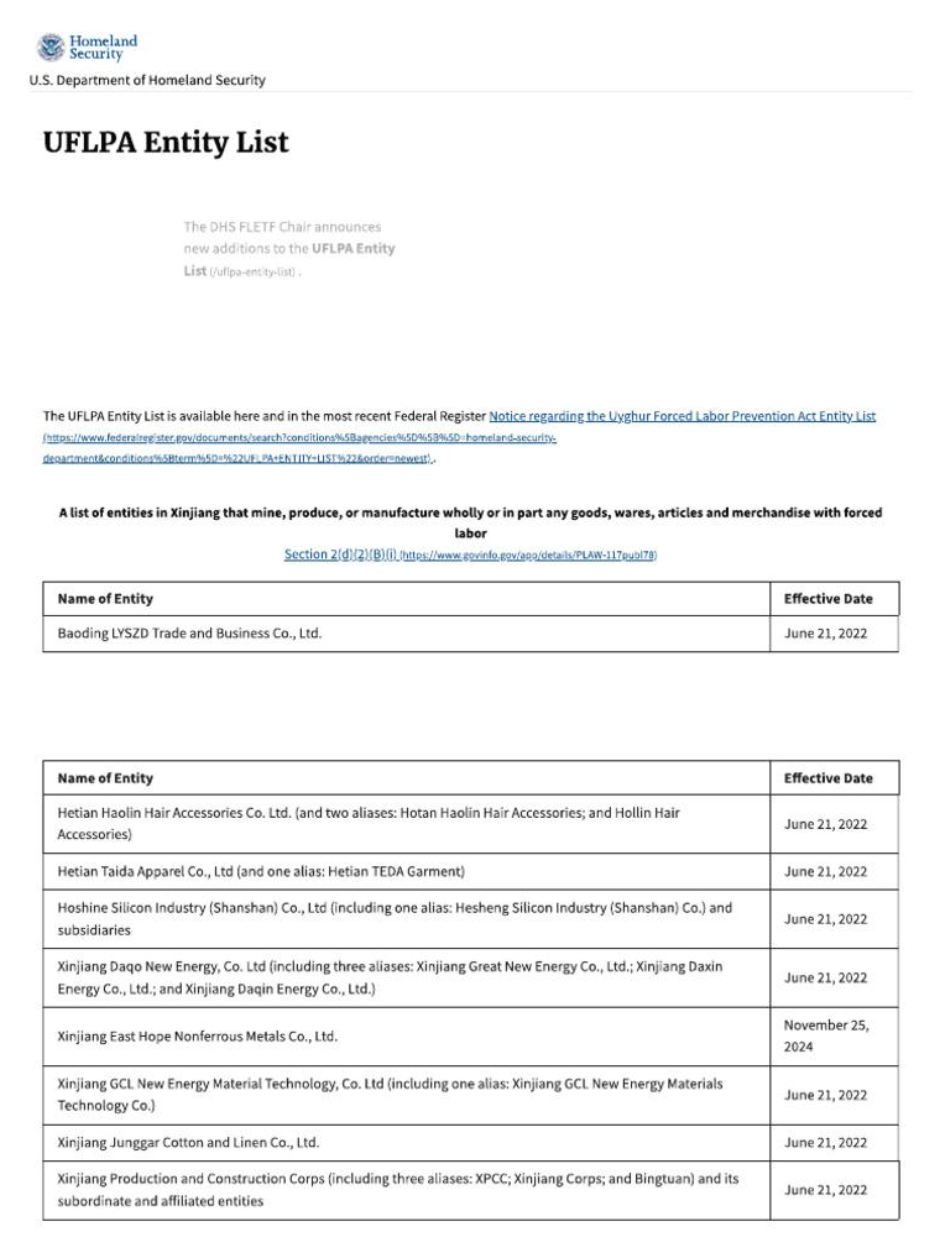
Beijing then publicly denied the existence of forced labour in Xinjiang and accused the United States of using domestic laws to use economic coercion to disrupt global supply chains.
But where the system is truly lethal, it is not just in Xinjiang.
In the United States, enforcement of forced labour has in recent years been increasingly concerned with the relationship between business interests, raw materials, processing and procurement. As long as the upstream chain of the supply chain is linked to listed businesses or Xinjiang production, the final export of United States goods may face seizure and review.
In other words, the list is moving from “sanctions against Xinjiang enterprises” to “tracking Xinjiang supply chains”.
This has forced multinational enterprises to re-examine cotton, photovoltaic materials, metals, textiles, car parts and other Chinese manufacturing chains. If an enterprise cannot prove where the raw materials came from, it may assume the risk of the goods not being able to enter the United States market.
The Chinese Government refers to this as political repression against Xinjiang, while the United States Government claims that its aim is to prevent forced labour products from entering the United States market. What really happened behind the two narratives was that for the first time human rights policies had become a supply chain access system on a massive scale.
In the past, foreign Governments have condemned the issue of human rights in Xinjiang mainly through statements and sanctions against officials.
Now, the costs are beginning to appear in containers, customs declarations and enterprise procurement systems.
This is also the long-term external cost of CCP’s policy: even if Beijing rejects international human rights criticism, companies must answer a more specific question from their clients and customs – who actually manufactures the product.
Article discussion
Verified members can discuss this report publicly and manage their own content.
Checking member sign-in status…