
While the Communist Party has constantly called for the “removing of the common people” and the promotion of ecological burials in the open, Xenjiang al-Zhigori forest has been exposed to a large number of illegal cemeteries, family graves and luxury graves. The scene shows that some of the mausoleums were directly built on forested lands and on the waste slopes, with large graves and walled up between the hills; Some of the graves are not fully equipped, with only a bare wall, a sale of telephones and pillars that delineate the boundaries of the graves, but are still operating in public.
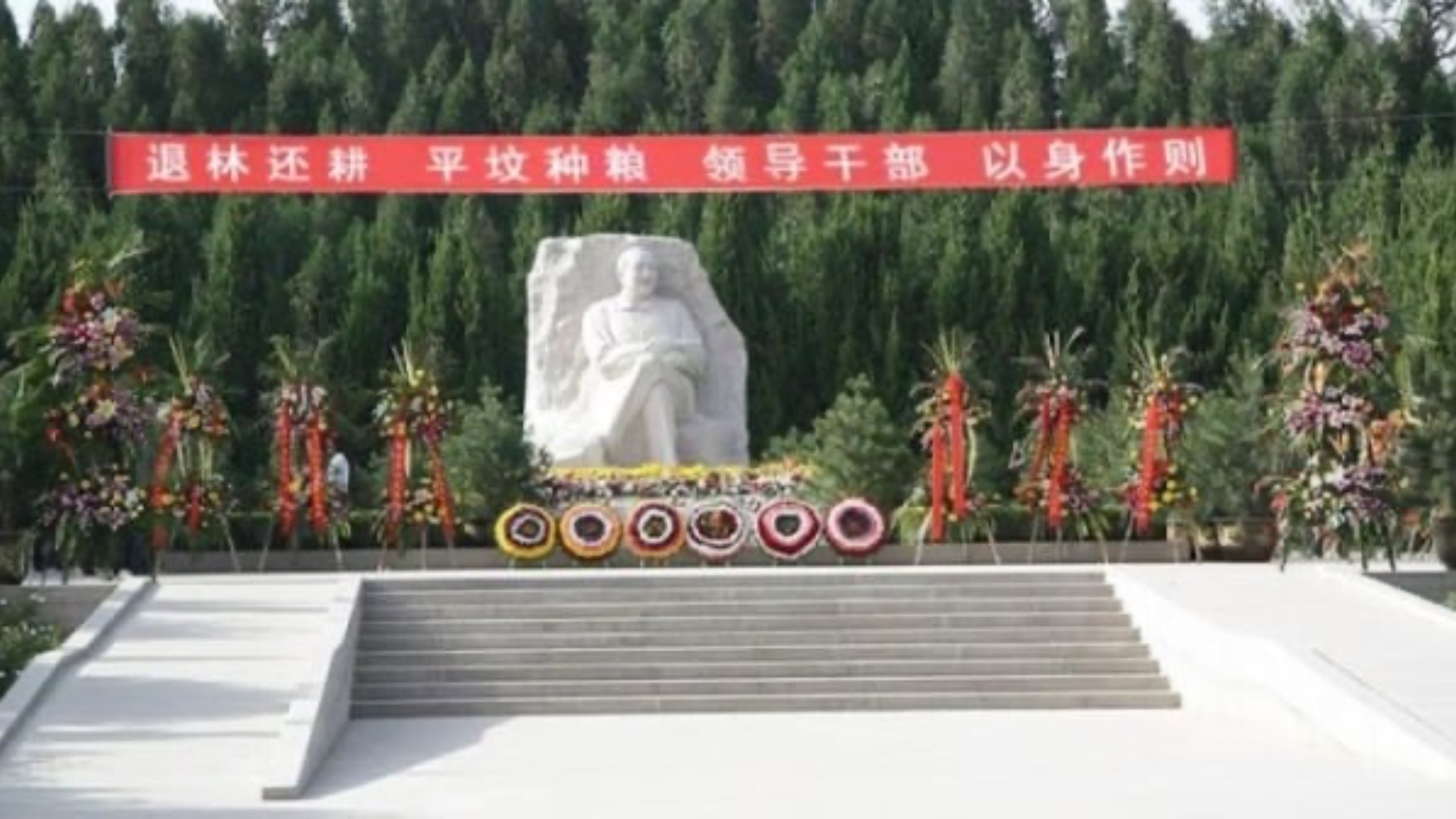
Even more ironically, in the same Sussi, ordinary people bear a high cost for a cemetery, and a large number of local cemeteries are being rehabilitated for illegal occupation, while the supreme power of the Communist Party has large estates officially named, maintained and promoted. The Xi Changhing Mang Park, located in Fuping, Shangxi, has long been classified as a “patriotic educational base” with the front seat of the learned Changhing King, where political slogans such as “retired, flat-grained, leading cadres, by example” are being displayed.
However, it is the slogan that calls for the cadres to “square food, by example”, which is a near-unusual contrast with the mausoleum itself.
Who was asked to level the grave? Who is asked to save the land? Who really owns the great mausoleums, statues, squares and official memorials?
Elm Hills are cut by cemetery, illegal business is openly conducted
From the photographs of the scene, it appears that a number of hills in the Elm forest have been cut off from the cemetery.

One picture shows that the entrance to the mausoleum was marked with a large sign indicating the “Wanfung Hill” and company name, contact number, and that the inner path of the cemetery was extended directly to the deep end of the mountain forest. In another picture, the concrete wall was sprayed with “graves” and contact telephones, operating in an extremely poor manner, but directly aimed at the community.
More photographs show that large slopes are heavily covered by white pillars. The boundary pillars have clearly served to delineate the area of use of cemeteries by splitting forest lands and landslides into plots of different sizes. From a distance, the cemetery is not sporadic but extends along the entire slope, with some areas already forming large mass graves.
In some areas, a closed family tomb is separated by the wall. Each cemetery occupies a few dozen square metres or a wider area, and the walls follow the mountains. These cemeteries are no longer individual graves in the ordinary sense, but are more like small cemeteries owned by private families.

A photograph of the site also shows a luxurious tomb built with a branded building, stone bars, stonestones and large fragrance stoves surrounded by pyrotechnic trees, with broad stone-painted roads laid in front of the grave. Its architectural specifications and area of land are clearly different from the general graves. Another photograph shows that several people are working on or conducting burials in the cemetery area on the slopes, suggesting that some of the cemeteries are not a historical legacy, but continue to be used and even expanded.
Together, these images present the fact that the charades are not an isolated grave, but rather a large-scale cemetery industry, with forest land, arable land and mountains.
From lease land to grave, land is turned into a commodity of all-powerful interest
As previously investigated, it was revealed that some cemetery operators in Elm have rented hundreds of acres of woodland and arable land from village councils or village groups at low cost, and have then divided the land into hundreds of dollars per square metre for sale to the grave buyers.
Operators do not even need to build formal service halls or complete funeral facilities. The sale of cemeteries can only begin when the area is set by a fence, a sign, a contact phone spray and a pillar.
Under this model, rural land, which is already extremely low, may rise hundreds of times when it is sold in the name of a cemetery. Funerals are no longer public services but are a business that depends on land price differentials for a large profit.
The new Funeral Administration Regulations, which were in force since 30 March 2026, explicitly emphasize the public good of the funeral service, require the strengthening of fee management and chain control, the introduction of landless or small-scale burials and the encouragement of ecological and land-based burials.
But the Elm site presents another reality: the mountains are being cut by walls and pillars, large family graves continue to exist, the estates without full public approval still leave sales telephones, and cemeteries continue to circulate as commodities in the market.
This means that the problem is never just that some people retain their burial habits. What really drives chaos is the chain of interests that is created by land windfalls, local power and ineffective regulation.
Why does a illegal cemetery last forever?
Hundreds of acres, even thousands of acres, were converted into cemeteries, which cannot be completed in one day.
From land rental, road construction, wall construction, the demarcation of grave areas, to public advertising, to fee collection and the continued construction of graves, each of these links is within the vision of local governments and grass-roots organizations.
The Civil Administration is responsible for the supervision of burials, the Natural Resources Department for land use, the Forestry Department for forest land protection, the Market Supervision Department for operations, and the Commune Government and Village Councils for direct control of local land use.
If such large cemeteries were to exist for a long time, they could no longer be interpreted as “failure to discover in time”.
What really needs to be answered is: who signed the land lease agreement? Who will allow the road and the wall to be built? Who knows that the cemetery is publicly sold? Which departments have been inspected? Why can we still work after punishment? Have proceeds of offences been recovered? Are regulators accountable?
In its earlier investigations into illegal mausoleums in other regions, China had found that, even if found to be in violation, such cemeteries were effectively demolished and rehabilitated. The case of Elm further illustrates that in the absence of open oversight and independent accountability systems, so-called ad hoc remediation often deals with only a few operators without touching on the power relations behind the illicit industry.
If a cemetery can operate for many years without legal formalities, it relies not only on market demand, but more likely on the acquiescence, asylum or participation of local power.
Why is Xi Chang-hoon's Mansion outside the rules?
A picture of the Elm Cemetery in which a piece of the waste slope was cut by a cheap wall and pillar; The Xi Changhon Mangung, located in Fuping, Shangxi, has squares, steps, statues, greening, wreaths and official political slogans.
Xi Jinping was the father of Xi Jinping and served as a member of the Political Bureau of the Communist Party, as a Deputy Prime Minister of the State Council and as a Deputy Chairman of the Standing Committee of the National People ' s Congress. His political status derives from the internal system of power of the Communist Party, not from the mandate of the Chinese people through free and competitive elections.
According to the CCP, the General Secretary of the CCP is elected by the plenary of the Central Committee and is not elected by direct vote of Chinese citizens. The President of China is elected by the National People ' s Congress, not by the citizens of the country alone and directly.
Thus, the “party and national leaders” that the Communist Party calls are not, in essence, elected leaders freely authorized by the people, but are the rulers of a closed power system, after a single party monopolizes political competition.
The public has never had the opportunity to decide, through public elections, whether Xi Chang-hoon should hold a high-level position in the State, nor has it ever been asked whether it agreed to use land and public resources to build large estates for him.

There are clear differences in the public information about the specific size of the Xi Changhung Mang Park. There are information on the mausoleum and the area concerned, which is about 100,000 square metres; It has also been reported that the memorial park around it has undergone expansion before and after Xi took power, and claims to be at least 100 acres. The lack of complete disclosure of the land approval, construction budget, funding sources and long-term maintenance costs makes it difficult to independently verify the actual scope and public inputs.
It is this lack of transparency that constitutes the core of the problem.
Ordinary cemeteries are subject to civil, land, forestry and market supervision; (b) The average family is required to observe the size limits, to pay for the graveyard and to pay for the management; But who reviews the mausoleum of the father of the Supreme Leader? How is land acquired? Who approves the expansion? Who will bear the cost? Are they subject to independent audit?
Under the one-party authoritarian system, there is no independent media that can freely investigate the supreme power, no independent parliament that can demand a public budget and no independent judiciary that can examine whether there is a conflict of interest. This has made the Xi Changhung Mang Park de facto a power-free zone that is beyond the control of ordinary society.
“Culture to grow food, by example” becomes the greatest political irony
The most striking of the photos of the Xi Changhon Mansion is not just a big statue and a wide step, but a red sign above the Mansion:
“Retired, laid food and led the cadres, by example. The blogger adds:
This slogan, which was originally intended to project a political image of zealous and subservient policies, was a strong irony when it was hanged on a large leadership mausoleum with a size far beyond the ordinary tombs.
The graves of ordinary farmers can be flattened for the rehabilitation, the ordinary family is required to abandon traditional burials and the general grave is restricted to a very small area; The Chinese Communist Party leaders who demanded “square food” from others, after their death, had statues, squares and mausoleums that had been maintained by the official authorities for a long time.
This is not simply a difference of words or deeds, but rather the most visible manifestation of the hierarchy of power in the Communist Party.
For ordinary people, “secular burial” is an administrative requirement that must be implemented; For the king, the “comon” is redefined as a red education base, a party history education base and a public memorial facility.
In the name of politics, the large tombs are no longer called mass graves, the land is no longer considered a waste of land, and the rear-up arrangements of the powerful family are even wrapped in the political education that the people must receive.
This is the institutional logic of the CCP system: the same land, the common man occupied “pastic” and the powerful occupied “patriotic education”; The home graves of ordinary people are the object of rehabilitation, while the mausoleum of the powerful family becomes a political holy place for visits, flowers and worship by government organizations.
The Communist Party did not eliminate the feudal privilege but rather rebuilt the political noblery system
The Communist Party has long declared that it will overthrow the feudal system and eliminate the privileged class, but reality shows that it has merely replaced the royal lineage with the rank of party and re-established a political order of nobility.
(a) The ancient emperors inherited power by descent and built the mausoleum after death; The CCP has power through the organizational system within the Party, and after death, local governments build mausoleums, homes and memorials.
The ancient mausoleum is a symbol of royal authority, and today's leaders' mausoleums are packaged as “red tourism” and “patriotic education”.
Even more alarming is the fact that the Sunsung Mansion is not a historical relic that has nothing to do with real power. His son Xi is currently in the top power of the Communist Party, the Government and the army, while his father's estate was expanded and politically promoted during his rising power. Even without public evidence that Xi himself had directly ordered, the initiative of local officials to expand to accommodate the highest leaders also revealed political philosophies and power dependency in the authoritarian system.
Under a democratic system, memorial works involving immediate family members of the current State leader should be subject to parliamentary, media, auditing and public scrutiny; Under the Communist Party system, such projects are covered by political exclusion.
Those who question may be accused of attacking “revolutionaries” or challenging political authority.
Ordinary: I'm a living man, I'm a dead man, I'm a dead man, I'm a dead man, I'm a dead man.
The reality of ordinary Chinese people is even more bleak than that of the political mausoleum of the ruling Communist Party.
Many families spend two generations of their parents and children on a mortgage to buy a home. (a) When a person is alive, most of his income is given to real estate, banking and land finance; After their death, the family is also required to pay for the transport, refrigeration, farewell, cremation, urn, graveyard and management of the remains in an extremely short period of time.
The grief caused by the death of a relative left the family with little bargaining power. Funeral services can use information intransparent, time-critical and traditional attitudes to increase the price of the service hierarchy that should have been of public interest.
The new revised Funeral Regulations, which specifically require the listing of services, prohibiting fees outside the list and requiring the authorities to curb excessive charges, in itself demonstrate that the funeral fees and the high burden have become an inescapable social problem.
(b) The purchase of a house by ordinary people, with only dozens of square metres of living space; The purchase of graves after death may be unbearable even for a square metre.
The CCP, who have never been freely elected by the people, can, by virtue of their political status, continue to occupy large areas of land after their death, with official protection, the organization of flowers and the demand for education in the minds of ordinary people.
This is not a simple gap between rich and poor, but a hierarchy of power-making life and death.
Who is the reform of funerals?
Harlem illegal cemeteries, family graves and luxury graves must of course be investigated in accordance with the law and the illegally occupied land should be dealt with. But if the cure is directed only at private operators and ordinary people, and never touches the Chinese Communist Monuments, the so-called funeral reform is a selective governance.
For the general population, the reform implies limiting the size of cemeteries, changing traditional practices and bearing high costs;
To local interests, cemeteries mean coitus, graves and windfalls;
For the ruling Chinese Communist Party, the mausoleum means political memorials, family honours and official offerings.
Thus, the real life outside the funeral reform is not only for the illegal cemetery operators of the Zirin, but also for the elites of the Communist Party, which are above the law and over public scrutiny.
(a) On the slope of Elm Hill, a concrete wall with a graveyard sales telephone and a moored weed with pillars dividing the tomb; In the Fuping Mansion, Xi Chang-hoon sits on the statue, and steps, wreaths and political slogans together constitute a place of power remembrance.
The two graves, which appear to be different, are created by the same system: one that transforms land into a profit commodity and one that transforms power into a back-up privilege.
Before the Chinese Communist Party demands that the Chinese people save their last square metre of land, they must first answer:
Why should he have large estates that are officially maintained, such as the party power chief, who has never been freely elected by the people? How much land do these estates occupy? How much public money have you invested? Who's going to approve it? Who's gonna supervise it?
Why can a common man's grave be levelled and a powerful mausoleum be used as a patriotic educational base?
Why should so-called funeral reform be aimed at reforming only the disempowered people, but never at reforming the political family in power?
That is the most inescapable institutional truth behind the luxurious tombs of Elm and the mess of the family.
Article discussion
Verified members can discuss this report publicly and manage their own content.
Checking member sign-in status…