

In August, China’s exports increased by 25 percent, imports increased by 28.2 percent, and the monthly trade surplus reached $1190.9 billion. At first glance, this is a record enough to celebrate Beijing: tariff pressure has not defeated Chinese manufacturing, global markets are still absorbing Chinese goods, high-tech exports have even grown by 42.9 percent. But what really is worth asking is not “how much China can still sell,” but another more dangerous question—why can a so strong export economy still not allow its own population’s consumption to be the core driving force for growth?
Customs data released by Reuters on September 8 showed an increasingly extreme structure: factories continued to produce, overseas purchases continued, trade surpluses continued to accumulate, while China’s domestic demand remained weak.
原始来源 · reuters.comChina's exports jump 25% in August as imports surge路透社9月8日报道中国8月出口同比增长25%、进口增长28.2%,贸易顺差继续扩大,而国内需求仍显疲弱。reuters.com ↗The more busy the port, the more unable to prove the average Chinese’s wallet is more drumming.
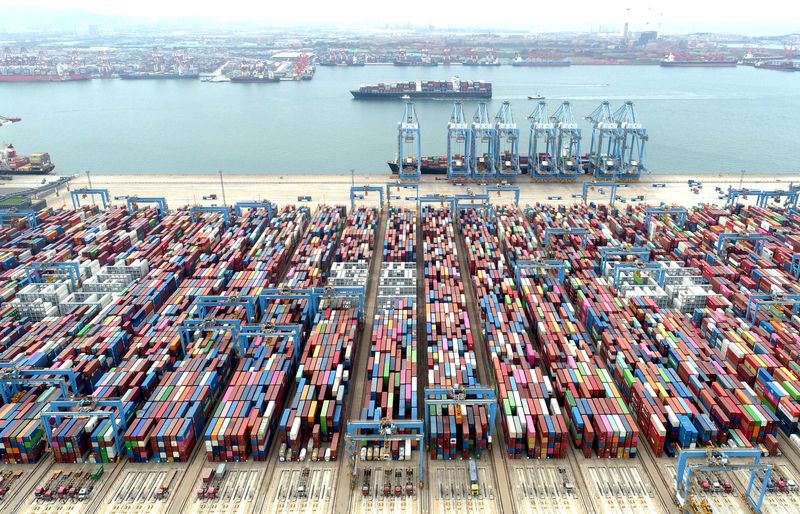
Export growth, of course, creates orders and jobs, but to equate the total exports directly to the wealth of residents, is one of the most common concepts of the Chinese economy propaganda. an economy can have the world's largest manufacturing capacity, can also simultaneously have low wage growth, real estate wealth decline, youth employment pressure and residents consumption caution.
China’s current core contradiction is not that it can’t produce, it’s that the production capacity is too strong, and the resident sector doesn’t have enough income, confidence, and social security to consume those capacities.
“When a country with a population of 1.4 billion is increasingly dependent on foreign consumers to digest its factory output, the problem is no longer just trade competition, but structural deviations in income distribution and economic systems.”
25% export growth, behind the revenue distribution problem that Beijing is unwilling to really solve
China's economy has long been predisposed to investment, industrial production and local government-dominated development models. land finance, infrastructure, real estate and manufacturing expansion have jointly produced high-speed growth, but this model concentrates a lot of resources in the government, state enterprises, local financing system and production ends, and the share of resident consumption in the economy is long-term low.
What Beijing has to do to truly expand domestic demand is not a mystery: increase the share of residents’ disposable income, reduce the uncertainty of healthcare and education pensions, reduce the long-term debt pressure on households for housing, and give the private economy more stable ownership and policy expectations.
The problem is that these reforms mean that the state has to really hand over some of its resources and controls to its residents and markets.
The Communist Party of China is willing to issue consumer bills, but does not want to touch the more fundamental question of how much the country takes and how much the residents leave.
The so-called “new-quality productivity” is facing the simplest common sense of the economy: something has to be built and someone has to buy it.
Electric vehicles, batteries, solar equipment, machinery, electronics, and increasing high-tech manufacturing are areas that Beijing's industrial policy focuses on supporting the rapid formation of capacity through credit, land, subsidies and industrial funds, but administrative forces cannot create endless demand.
When domestic markets cannot absorb all of the new capacity, enterprises naturally turn overseas.This explains why China's export competitiveness and other countries' concerns about "excess capacity" will increase at the same time.
From the perspective of Beijing, this is a manufacturing advantage; from the perspective of the importing country, it may mean that the local industry is subject to price competition supported by Chinese policy capital.
So China’s internal economic imbalances began to spread to the outside.
- Inadequate domestic consumption, enterprises are more dependent on exports;
- The stronger exports, the greater trade surplus;
- The greater the surplus, the stronger the political pressure of trade partners;
- After countries raise tariffs and investment restrictions, Beijing also blames foreign "protektionism";
- Chinese enterprises then look for new markets in Asia, Africa, Latin America and Europe to continue to release capacity.
This is not a pattern that can be unlimited circles.
The longer China delays domestic reforms, the more intense the trade friction with the world will likely be.
The U.S. is not the only economy to be cautious about China’s industrial policies.Europe, India and several emerging markets are reviewing the industrial impact of large amounts of Chinese goods entering their own markets.
Beijing has often interpreted these reactions as Western restrictions on China’s development, but this statement deliberately avoids a key fact: if Chinese residents can consume more of the goods they produce, Chinese companies will not have the strongest incentive to rely on overseas markets to maintain capacity utilization.
In other words, part of the root of global trade friction is actually in China.
A Chinese economy that relies more on consumer consumption and less on government investment and industrial expansion will not only be healthier for Chinese households, but will also reduce the pressure to export excess capacity to the world.
The real sacrifice is the opportunity for Chinese residents to become economic subjects.
The deepest question of the CPC economic model has never been whether GDP growth is 4% or 5% or 6%, but who has the power to decide how resources are allocated.
In a society where residents have stronger property rights, more reliable social security, a more free private economy and a more transparent fiscal system, families do not have to bear so much uncertainty for health care, retirement, education and housing, and consumption naturally gains a more stable foundation.
But the authoritarian regime prefers another growth: the government determines the direction of the industry, the banks coordinate the national strategy, the locals wrestle projects, the enterprises expand capacity, and then the statistical digital proof policy is “right”.
The 25% increase in exports is therefore not proof that China’s economic problems have been solved, but rather a brighter warning light.
It tells the world that China’s manufacturing machinery is still powerful; it also tells the Chinese that the machine has not yet completed the most important shift – from serving the country’s growth goals to truly serving the lives of its inhabitants.
The Communist Party can continue to rely on exports to extend the lifetime of the old model, but can’t forever avoid the most basic question: If China’s economy is really so strong, why does it always need foreign wallets, more than Chinese wallets?
Article discussion
Verified members can discuss this report publicly and manage their own content.
Checking member sign-in status…