
A new regulation of the Ministry of Public Security, which is ostensibly aimed at monitoring cybersecurity, is further extending the regulatory tentacles of the Chinese public security organs to network content, data processing and personal digital activities.
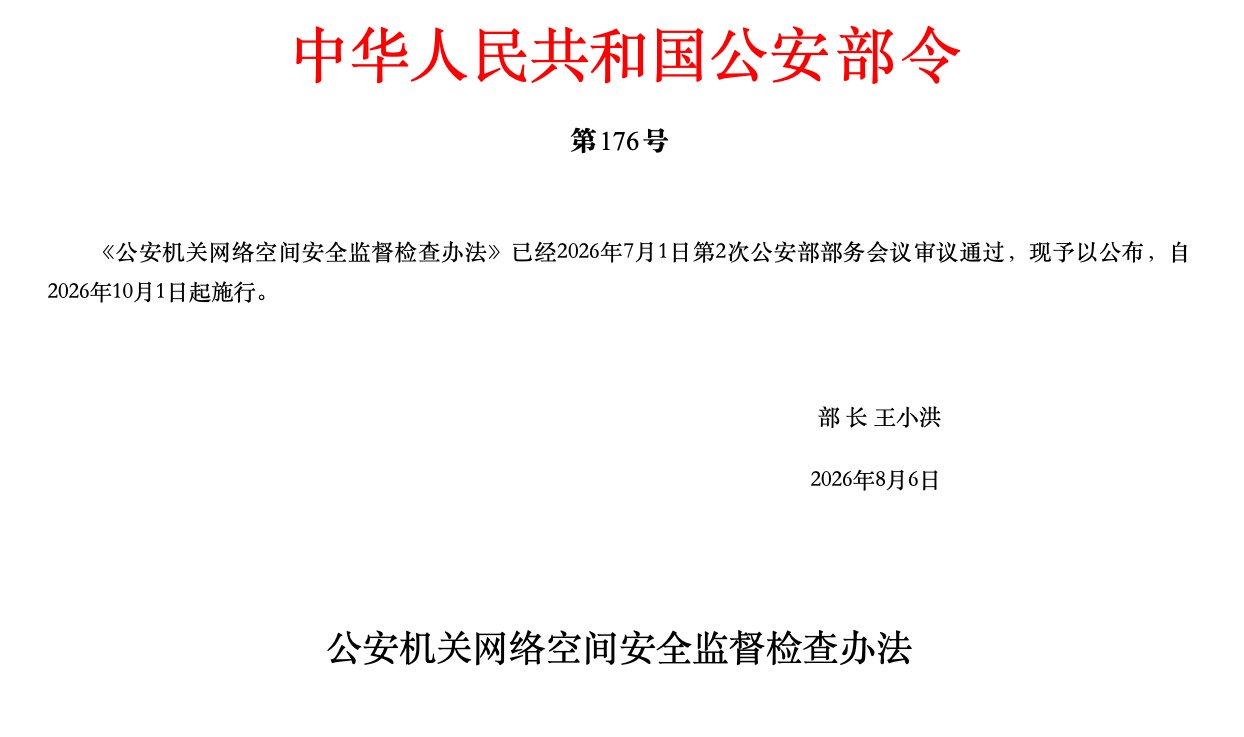
The Measures for Monitoring and Inspection of Cyberspace Security of Public Security Organs, published by Order No. 176 of the Ministry of Public Security, will be in force as of 1 October 2026 and will replace the Regulations for Monitoring and Inspection of Security over the Internet of Public Security Organs of
- The expansion of the regulatory logic has been demonstrated by name changes: the old rule emphasizes “Internet security” and the new rule is replaced by “cyberspace security” with a broader coverage. The consultation draft previously published by the Ministry of Public Security clearly explains that cybersecurity in this area includes both cybersecurity, information security and data security. (Ministry of Human Resources and Social Security)
This change cannot be understood from a technical regulatory perspective alone. (b) Public security inspections of Internet units in the past, which focused on security systems, network loopholes, real name registration, logkeeping and the disposal of illegal information; The new institutional framework further incorporates data, information content and ideological issues closely related to political security into the same system of public security oversight. The role of the public security organs is regulated by the detection of cybercrime and technical security, and they continue to promote the integrated control of the cyber society.
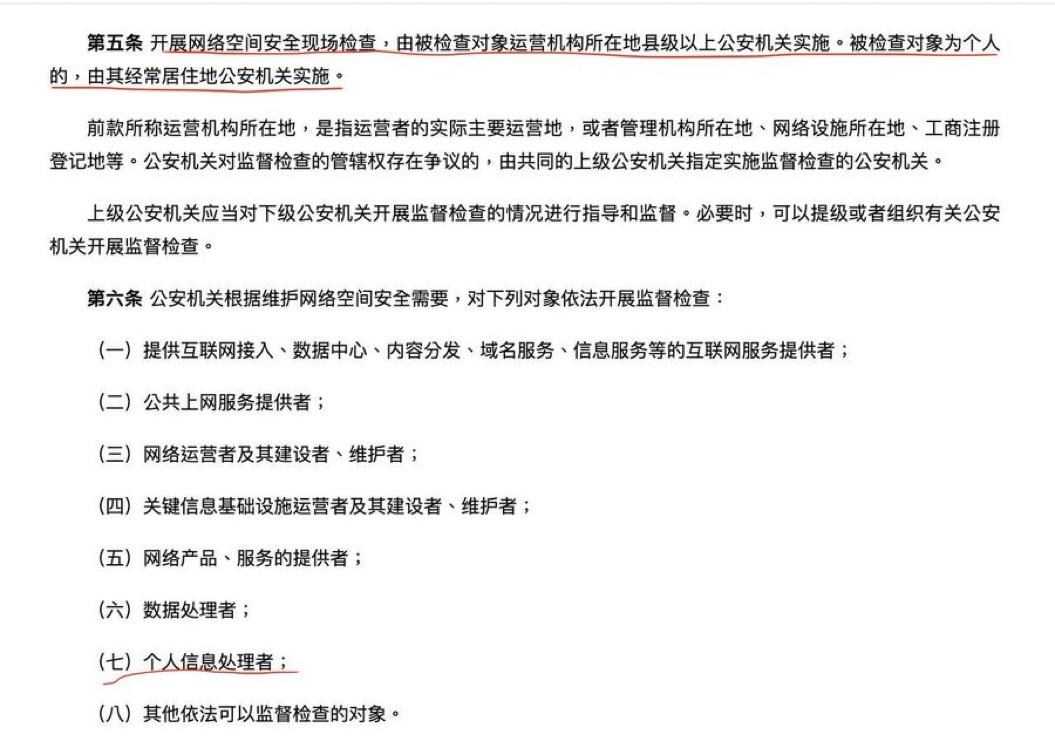
Of particular concern is the fact that the new approach has clearly introduced the requirement that “the subject of the examination be an individual”.
This does not mean that the public security organs can enter private homes and search mobile phones and computers at will by order No. 176 alone, and that the new regulations still contain specific restrictions on access to places on the scene. However, the system of “individuals” for monitoring and inspecting the security network space has itself shown that the border has changed: it is no longer confined to Internet enterprises, platforms, institutions and network units, and that individuals are formally subject to the rules of jurisdiction of the network of public security organs.
What really needs to be asked is the circumstances in which such individual-specific checks are initiated, who has the trigger standard and the extent to which personal digital information can be checked. The new regulations expand the institutional space for online patrols, on-site verification and technical inspection by public security organs, without simultaneously establishing a judicial mechanism that is independent of the public security organs and allows for a substantive review of the necessity and scope of inspections. This imbalance in power structure is particularly dangerous in the context of China ' s current political and legal system, as the public security organs are not an enforcement agency that is subject to the continued external constraints of an independent judicial system, but are an important part of the Communist Party system.
The more political changes in Decree No. 176 are the further introduction of “information security” and “cyber-ideological security” into the system of public security oversight.
Cybersecurity could have had relatively clear technical implications, including the prevention of hacker attacks, system intrusion, data leakage and the breakdown of infrastructure. However, in the Chinese Communist Party governance context, cybersecurity has long been intertwined with political security, information control and ideological management. The revised Cybersecurity Act continues to provide for the State to maintain security and order in cyberspace, while requiring the promotion of “socialist core values”, which has enabled network governance to have a clear political content management attribute from the outset. (National Internet Information Office)
Decree No. 176 further introduced this logic into public security supervision and inspection.
When the content of the inspection by the public security organs extends to information content, content orientation and cyber-ideological security, what can be disseminated and what can be considered harmful on the Internet is no longer a matter of internal review on the platform, but may be directly linked to the enforcement of public security. This is particularly important for the Chinese context of speech, as the vast amount of information that has been removed, blocked or pursued is not a traditional aspect of cybercrime, but rather relates to political criticism, public events, advocacy, religious issues, human rights issues and accountability for the failures of the Communist Party in its governance.
In recent years, China's practice of cybergovernance has proved that the so-called “cyber order” has never been aimed only at fraud, pornography, hacker attacks and violent crime. In January of this year, the Ministry of Public Security publicly concluded its work in 2025 by placing the maintenance of national political security, combating cyberfiction, cyberviolence, cyber-saic forces and strengthening cyber security, data security and information security in the same governance framework. This expression indicates that there is a strong link between political security, information security and cyber content governance in the system of governance of the public security organs themselves.
Decree No. 176 provides for a more complete system of supervision and inspection of this connection.
Since Xi took power, the Chinese Communist Party has expanded the scope of its “national security” coverage. Networks, data, finance, culture, education, religion, overseas contacts and even public opinion are increasingly being handled within a security framework. The most significant change that this way of governance has brought is the fact that State power, which should be subject to clear legal restrictions, can be constantly promoted within society through an extremely broad concept of “security”, and it is increasingly difficult for citizens to obtain stable and clear criteria of judgement on which line they cross.
This uncertainty is in itself an important means of reducing the space for speech.
While Chinese Internet users have faced long-standing redundancies, seals, silences and platform reviews, the platform reviews still, at least formally, fall under the regulatory responsibility of Internet enterprises. The risk behind the expression of behaviour ceases to be a matter of account sanction when public security oversight further enters the realm of cyber content and ideology. The data, web logs and content disposal records available to the Platform may be used as information that can be consulted and replicated in public security monitoring inspections, thus creating a closer link between the Platform ' s oversight and public security powers.
Decree No. 176 also strengthens the capacity of public security organs to carry out inspections using technical means. According to the previously published text of the Ministry of Public Security, monitoring and inspection can be carried out through the use of Internet information inspections, information-checking capability tests, and the scanning of loopholes, and the establishment of public security organs at the district and above levels can also organize the detection of loopholes and the testing of permeability. This means that the Public Security Network is no longer merely waiting for the submission of documents or receiving on-site visits from an enterprise, but has the institutional basis for taking the initiative to enter the technical examination chain.
From a purely cybersecurity perspective, the detection of loopholes and technical inspections are not natural and unreasonable. The problem is that when the same body is also responsible for the monitoring of cyber-technology security, information on violations, political security and ideologically related oversight, the technical examination of how the data obtained is isolated from other public security operations is an inescapable right.
The problem is compounded by the fact that the current Chinese system lacks an institutional environment that allows for a genuine independent review of public security powers. The public security, prosecution, courts and political and legal organs are under the leadership of the Communist Party, and Xi has long emphasized the central unity of party leadership in the political and legal sphere. Under this structure of power, the requirement that public security organs “use information in accordance with the law” or impose a duty of confidentiality on staff members can only constitute internal norms and cannot replace a truly independent external checks and balances.
Decree No. 176 also institutionalizes special inspections during major security missions. This means that, at a time when the Chinese Communist Party considers that political risks are rising, the public security organs have a clearer system based on enhanced cybercensorship. China has repeatedly experienced a marked escalation of cyber censorship, restricted social accounts and obstruction of the dissemination of sensitive information during major political meetings, sensitive days and public emergencies; The new regulations further integrate special inspections into the formal system, so that this temporary political security instrument is more stablely administratively supported.
What really changed here is the power structure of network censorship.
In the past, China ' s Internet control relied heavily on Internet services to set rules, implement filtering on platforms, and public security to handle cases that were found to be illegal or to threaten political security. Decree No. 176 reflects the trend that public security organs are moving more deeply into the front-end monitoring chain, conducting direct inspections of the institutional construction, information handling, data security and content management of the network ' s subjects. This will place a greater degree of cooperation on the Internet platform when faced with the public security authorities and will further enhance its preventive scrutiny of users.
For ordinary citizens, the final consequences do not need to be in the form of large-scale arrests.
When a person makes a statement in a micro-intelligence, microblogging, short video platform or group chat, it is natural to self-censor when it is not clear what is to be considered as “harmful information in violation of the law” and what subjects touch what is called “ideological security”. The space for a society to speak is really being reduced, and it is often not all people who are forbidden to speak, but more and more people who have begun to calculate potential public security risks before they speak.
This is also the core effect of the growing Chinese network control in Xi’s near-Ping era.
The Communist Party has established one of the largest network censorship systems in the world, but it is continuing to expand its network of public security, cyber-mail and control between platforms. Decree No. 176 shows that Beijing does not view the Internet as a public space requiring the expansion of freedom of expression for citizens, but rather continues to reshape the cyberorder in accordance with the logic of political security and social control.
When “ideological security” can be a matter of public security oversight and inspection, when individuals have access to the regulatory system of cybersecurity oversight, when public security has the capability to conduct online patrols, copy information and technical detection, it is no longer a matter of just deleting an article or sealing an account. It is being transformed into a complete institutional chain extending from platform responsibility, data monitoring and technical inspection to public security enforcement.
What is really of interest to the outside world is not how many additional inspection procedures were added to Decree No. 176, but how much political structure were ultimately served by these procedures.
Cybersecurity checks can be subject to a strict power border in a system that allows independent media investigations, independent court review and parliamentary oversight of law enforcement agencies; In the CCP system of State under Xi Jinping, the public security organs themselves are an important and compulsory force in the defence of the political rule of the Communist Party. The further integration of the content and ideology of the Internet into the oversight system of this body means that the distance between the State ' s coercive powers and the expression of citizens is continuing to shrink.
As of 1 October, Decree No. 176 will formally enter the implementation phase. What is really needed is for the public security authorities to identify “individual” targets, what content goes into the “ideological security” controls, what user data they can obtain during the inspections, and whether they will be further integrated into the national security, security and criminal law enforcement systems.
These practical cases will determine what kind of institutional tool Decree 176 will eventually become.
But one direction is clear from the text that has been made public: while Xi's regime continues to govern society with political security, the Chinese cyberspace has not evolved in a more open direction, and public security powers are being further integrated. The space for speech, which had been reduced by firewalls, real names, account reviews and the layers of the platform ' s monitoring, was also subjected to an additional institutional pressure from the public security oversight system.
Article discussion
Verified members can discuss this report publicly and manage their own content.
Checking member sign-in status…