
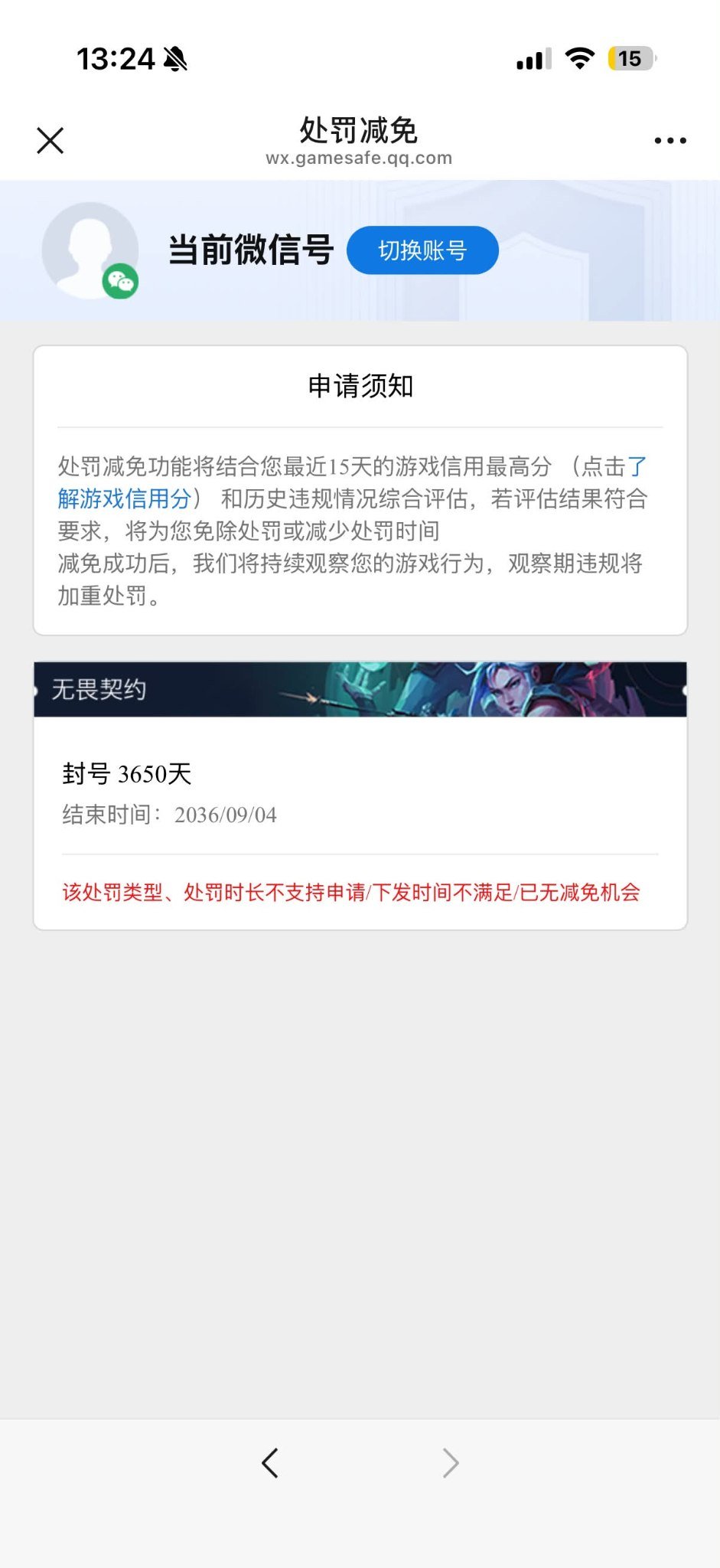
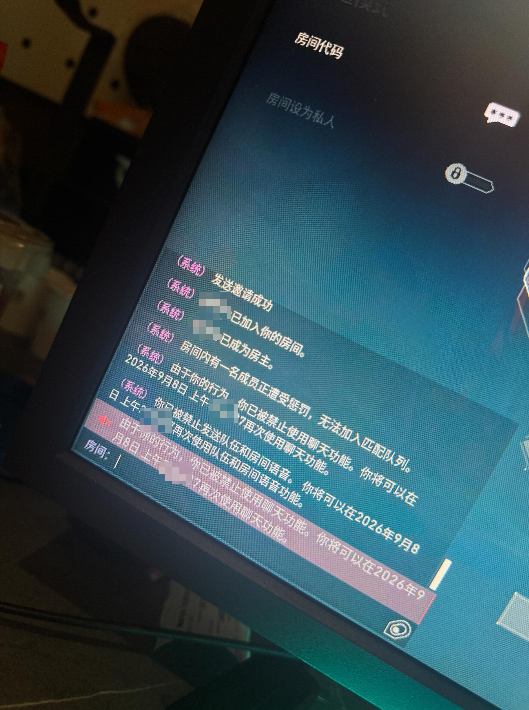
September 8th, , a "dauntless contract" national dress player says he only said "Trill" in his play voice, "nopener noreferrer" data-linked-reference ="true" data-reference-label = "X": "Telegraphy" after a player says that he only said "Trivalian" in his "Si Jinping" speech, "nopeer no bad words", and then was systematically banned from talking and about a minute later, "Team and room voice" function. The web-based cut-off shows that the relevant account was in a limited state of conversation and voice, recovering at 3.06 a.m. on 8 September 2026, and that there was a hint that “one member was being punished and could not join the matching queue”.
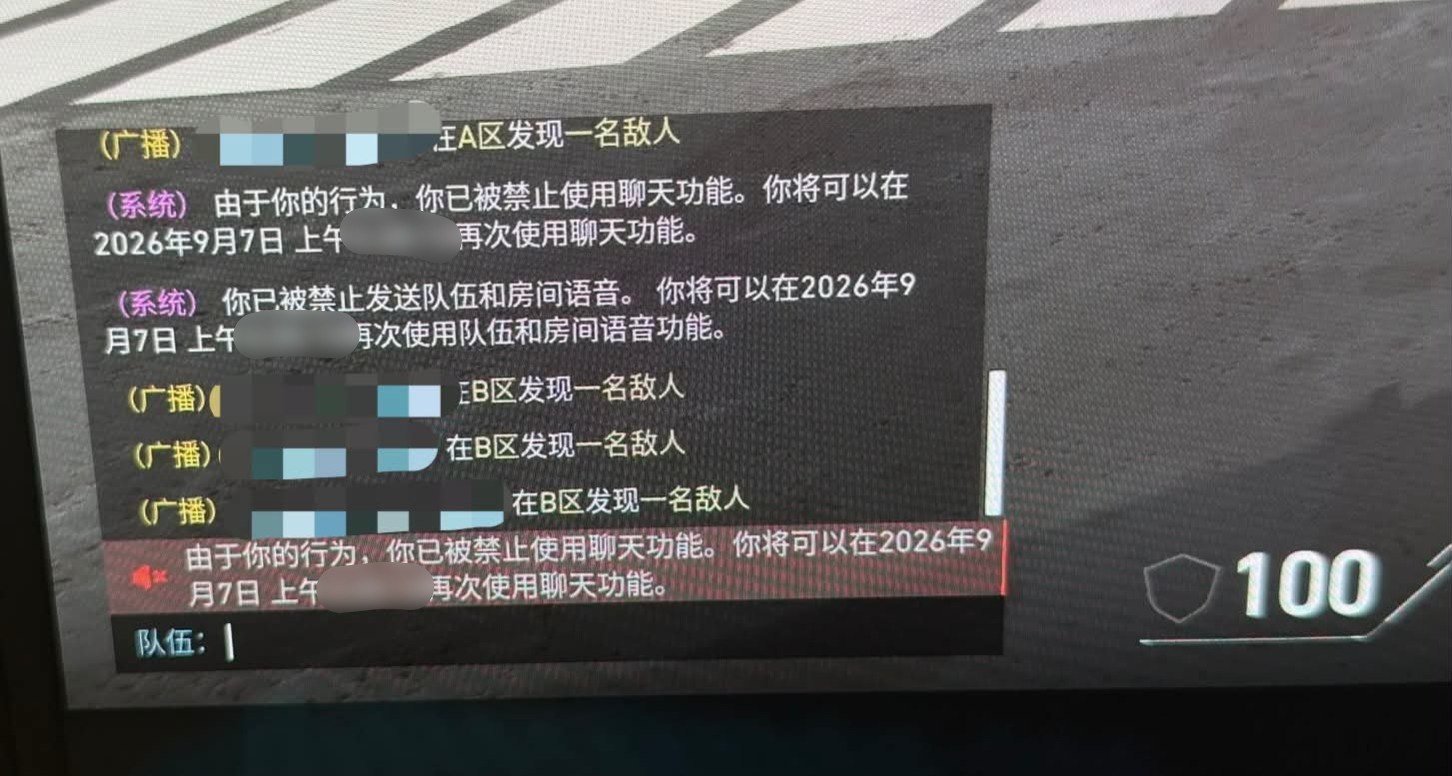
It is important at this stage to make a strict distinction between two matters. First, there is support for this in the form of a cut-off; Second, “punishment is triggered by the name of Xi Jinping only” and is still a single player's statement, without a complete video, background or official response to be independently substantiated. It is therefore not strict to write this case directly as “the Queer requires that Xi Jinping be cut off”.
It is really worth investigating not only why this player is being punished, but whether the real-time voice management of the Narrow Compact State uniform has incorporated political sensitivities into the automatic identification and punishment system and whether the player is able to know which rule he is touching.
The punishment cut-off diagrams can prove anything, nothing.
According to the pictures displayed on the post, the player account was restricted to chatting and to the team, room voice, while influencing matching. Such an interface would have proved that the account number was indeed subject to Platform sanctions at the time, but it did not show the specific language that triggered the penalty or the process of determining the violation. It is therefore not possible to exclude other possibilities, such as the existence of other previously spoken content, text messages, player reports or systematic treatment based on behaviour over longer periods of time.
This evidence boundary is very important. Social media are the easiest to write “times in order” as “relationships”: the players first name a politician and then the account numbers are punished, and the two are directly connected. However, professional investigations must continue to ask whether the Platform records the trigger, whether the penalty is automatic or manual, whether the system judges the context and whether the user can access evidence of specific irregularities.
“Politically sensitive content” as a category of punishment is in itself worthy of public explanation
The Nest Pact contains a separate “politically sensitive” section of the penalty rules for the Nest-Counter-Countainer's network, which incorporates language and terminology that are politically sensitive and related metaphors. "The Narrow Pact" operates from </a" on the mainland of China, with real-time communication functions such as text chats, team voice and room voice.
This means that, even if the direct causal link in the current case is still to be verified, the question of whether the Platform has implemented specific governance of politically sensitive elements has become an issue that can be independently investigated. If the rules do cover real-time voice, then users should have the right to know what expression constitutes a violation, whether there is a political name library, whether the system automatically transliterates the voice into words, whether there is manual review after machine recognition, and how the scale of punishment distinguishes between ordinary references, discussions, irony and verbal abuse.
Real-time voice is not the same space as public post
Traditional web censorship is most easily visible to the public, such as the microblogging strike, the disappearance of public-opportunity articles, the blocking of live broadcasts or the restricted search of keywords. These content is usually of an open dissemination nature, and the Platform can interpret its review mechanism by means of “public content governance”. The real-time voice of the game is different, and it often exists only between several players, with limited dissemination and duration and without necessarily creating a publicly retrievable record.
If political sensitive reviews have stabilized into this semi-private, instantaneous voice space, then the governance of the border has changed. The Platform is concerned not only with what the users publicly publish, but with what the users say to the Bureau at a short time. This relates not only to content rules but also to broader issues such as voice recognition, data preservation, automatic auditing and user privacy.
The most appropriate answer for the platform is “Does the rules understand”
A normal system of penalties should not only inform the user that “you have broken the law”, but should instead allow the user to understand the basis of the punishment. For abuse, harassment, cheating, etc., the Platform can generally provide the type of violation, time, record or basis for detection; But “politically sensitive content” is a broad label, without sufficiently clear boundaries, which allows users to guess only through a single punishment what can and cannot be said.
The Question of the State of the Narrow Pact can be answered at least publicly:
- Whether the play voice will be transliterated into text in real time or with delay;
- Whether politically sensitive content penalties apply to speech and not only to words;
- Whether the names of politicians themselves may trigger an audit or must be judged in the context;
- Whether the punishment is automatic, manual or combined;
- Whether the player can see the specific language and evidence that triggers the penalty;
- The existence of an independent complaints and manual review mechanism for politically sensitive types of punishment.
These issues are not requiring the platform to disclose all its elements, but rather to require the most basic procedures to be transparent. If users are unable to know what they are being punished for, it is difficult to judge whether the platform is implementing clear rules or a changing and unpredictable political boundary.
The non-transparent rule is the easiest to create self-censorship
The incident was spread rapidly and with a more remarkable psychosocial dimension than the case itself: a large number of netizens did not think that “showing Xi's name and being blocked” was an entirely unimaginable story. Even in the absence of back-office evidence, many people instinctively believe that such causality “may be established”.
This judgement is not made in vain. For a long time, Chinese Internet users have become accustomed to keyword filtering, account-number penalties, content deletions and political sensitivities that express the opacity of borders. When the Platform rules cannot be predicted accurately, users often do not wait for punishment to adjust behaviour, but limit themselves in advance. A truly efficient review does not require an explicit prohibition of a word at every time; It just needs to convince users that it can have consequences.
From this perspective, the incident would still be of investigative value even if it eventually proved that the player had other irregularities. It shows that in the minds of users, the names of politicians are already considered as a potential risk signal in themselves, and that this social expectation is itself a legacy of long-term content governance.
The conclusion of the “real hammer” cannot be drawn at this time, but the duty to make the facts clear
Focus China does not currently characterize this case as “Ci Jinping” being automatically hyped up on wheat. Insufficient evidence is available to support this conclusion. More accurately, a player claims that he was punished for speaking and talking after he had only given his name, that the intercepts proved that the punishment had occurred and that the reasons for the punishment were still further verified by the backstage records and the complete screens of the platform.
But it is not technically difficult for the platform to clarify disputes. The call could indicate which specific rule the account violated, the time at which the review took place, whether the penalty was triggered by the voice content and whether the complaint could be manually reviewed. If the punishment is not related to the political content, the specific grounds for disclosure can be quickly closed; If the platform refuses to indicate, the user can continue to speculate about the red line only through experience and fear.
The question that this case really raised is therefore not limited to a game. It is about a more general principle of digital rights: whether users have the right to know how the platform reviews real-time voice, whether they have the right to know the boundaries of politically sensitive rules and whether they can effectively challenge the punishment imposed by machines or manual means.
Focus China believes that when a common player gives the name of the top leader in a semi-private game voice, it is the political attitude of the player, but the rules of the platform, that needs to be made public when it comes to the need to worry about whether its microphone will be shut down. If digital governance can only be maintained by an invisible red line, then ultimately it is not freedom of conversation in a game that is weakened, but the basic trust of the entire Internet community in the knowledge of rules and procedural justice.
Article discussion
Verified members can discuss this report publicly and manage their own content.
Checking member sign-in status…