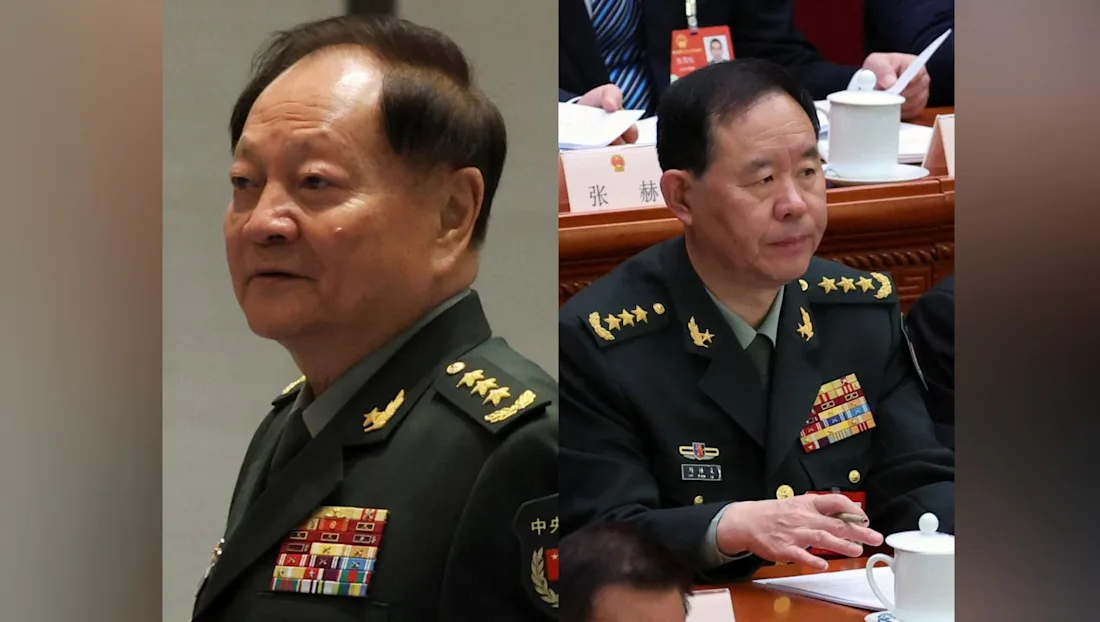
On 24 January, the official announced in only a few words that Zhang Chang Chau-man, Vice-Chairman of the Central Military Commission, and Liu Zhenli, Chief of Staff of the Joint Military Commission, had been investigated. Eight months later, the outcome was put to the ground: two persons were dismissed from the party, military and suspected of crimes were referred to the military prosecution for legal review and prosecution.
This is not an end to the fight against corruption in the ordinary army. Zhang Chang was a member of the Central Political Bureau of the Communist Party and first Vice-President of the Central Military Commission; Liu Zhenli, in turn, holds the core staff of the Joint Operational Command System. When the two persons disappeared simultaneously from the top command of the army, leaving behind not just two vacant posts, but a high-level chain of political decision-making to joint operational commands was re-opened.
Eight months from "Severe Infractions" to the Military Prosecution Office
On 21 September, the Chinese Ministry of Defence informed the Central Political Bureau of the Chinese Communist Party that it would consider and adopt the report of the Central Military Commission on the review of serious disciplinary violations by Zhang Zhang Zhang and Liu Zhenli, and decided to dismiss both of them; The Central Military Commission decided to dismiss the military. Officially, the two persons suspected of having committed a crime were referred to the military prosecution for prosecution.
The public briefing in January this year did not disclose the specific case, but only stated that the two individuals were suspected of “serious disciplinary offences”. The September disciplinary notice likewise failed to disclose the amount involved, the specific offence, the time of the case or the person concerned. That is, what is now possible to confirm from the outside world is that the disciplinary level and the case are already in military judicial proceedings, and that the facts of the specific offence cannot be directly derived from official material available.
This distinction is important. The reports of factional clashes, coups d ' états and leaks have been proficient in the past few months, but they cannot be a substitute for verifiable facts of the case until further information is published by the military prosecution or the courts.
原始来源 · channelnewsasia.com中国开除张又侠、刘振立党籍军籍CNA报道9月21日官方公布的处分及移送军事检察机关信息。channelnewsasia.com ↗The size of the Zhang Man, not in rank, but in position
Zhang Zhang is far more politically important than most military generals have been inspected in recent years. He has not only entered the Central Political Bureau, but has also served as Vice-Chairman of the Central Military Commission for a long time. As a military general born in 1950, he had a real experience of combat and was one of the most senior figures in the military hierarchy of Xi in the period of the Jinping regime.
Liu Zhenli is also not a regular technocrat. As Chief of Staff of the Joint Staff of the Central Military Commission, his position is directly linked to the Military Commission ' s decision-making and the joint combat system in the theatre.
原始来源 · aljazeera.com张又侠、刘振立今年1月被宣布调查今年1月两名高级将领被宣布接受调查时的公开资料。aljazeera.com ↗The two were out of the game at the same time, with two different levels of consequences: Zhang Jia-man left a political and organizational vacancy in the military committee leadership; Liu Zhenli left a critical professional vacancy in the highest military command.
This is also the case in the present case, which is different from the case of corruption in the procurement of simple equipment. It is not the military periphery that has been restructured, but the Central Military Commission and the Joint Staff System itself.
Anti-corruption has burned from the procurement of equipment to the top command
Over the past few years, the Chinese army has experienced a heavy personnel shock. Rockets, equipment development systems and a number of senior-level officers will lead the way and will be investigated or dismissed. In October 2025, 9 senior generals, including Ho Weidong, were dismissed from the party and were given military status; Last January, Zhang Jiang and Liu Zhenli were announced to be under investigation.
If these cases are to be linked, a clear change is the constant shift in the scope of the investigation to the military ' s core of power.
Early cases are more concentrated on the procurement of equipment, the military engineering system and specific military units; Subsequently, the Central Military Commission members, vice-presidents and the Chief of the Joint Staff were also brought to the investigation. This means that the military has moved away from just cleaning up procurement corruption and is restructuring the group of senior officers themselves.
The official explanation given remains the fight against corruption and discipline. The Chinese military has repeatedly stressed the need to remove corrupt elements, preserve the integrity and political loyalty of the army. The large-scale inspection of senior generals can be interpreted, in the light of the official governance logic, as strengthening discipline and the accountability of the Chairman of the Central Military Commission.
There is, however, a different facet of the fight against corruption: the constant vacancies in senior positions, the removal of generals familiar with joint combat and military management, and the increased costs of organizational re-engineering. Discipline and command stability are not natural objectives.
The real question is not who else to arrest, but who to take over
To observe the next stage of change in the Chinese army, rather than speculating about the next general under investigation, three more specific questions should be considered:
- How the position of Vice-Chairman of the Central Military Commission is filled. This position relates not only to the daily leadership of the military, but also to the promotion of senior generals and the division of labour within the Military Commission.
- How the Joint Staff maintains a continuity of command. Replacing of Chiefs of Staff relates to joint operational planning, training and coordination in theatre.
- Where will a new round of promotions of senior officers be chosen. If the generals of multiple systems are simultaneously disciplined, the subsequent promotion scope and the criteria for political review may change.
These questions are more easily validated through future appointments, the sequencing of the Military Commission meetings, promotion lists and public events than the story of “Whether a certain faction is losing its position”.
What it means to the Taiwan Strait, cannot be summed up in a simple answer
Zhang Zhang and Liu Zhenli were dealt with and were easily placed directly into the Taiwan War schedule. However, there is no public evidence at this stage that the two individuals ' disposition would directly change the Beijing policy against the Taiwan station, nor can it be inferred from this that a particular military operation would be sooner or later.
It is certain that the SPLA has continued to advance in recent years joint operations, area command and military preparations against the bases; Meanwhile, the highest military leadership has experienced a rare and intensive personnel adjustment.
The fact that both events are taking place at the same time leads to a contradiction that must be observed on a continuous basis: On the one hand, the highest leadership demands that the military be better prepared and more capable of joint operations; On the other hand, the senior chain of command, which is carrying out these tasks, is constantly changing.
For the outside world, the actual state of the military requires a determination of the size of the training, stability of the sector command, speed of filling key positions and performance of the training, rather than a mere political disposition to infer a sudden increase or decline in military capacity.
Comment: The more loyalty reviews go, the more professional chains of command need to prove themselves again
The most noteworthy aspect of the Zhang Dhakyan-Lao case is not the end of the personal career of two generals, but the structural challenges facing the senior administration of the Liberation Army.
Since Xi took office, the reform of the army has attempted to resolve two long-standing problems: first, to ensure political control of the army by the President of the Central and Central Military Commission of the Communist Republic of China (CPC) and, secondly, to transform the traditional military zone command into an organization capable of conducting modern joint operations. The former objective requires a continuous strengthening of political loyalty and disciplinary review; The latter goal relies on a stable, professional and experienced system of senior officers.
The tension between the two objectives became more apparent when the investigation entered the rank of Deputy Chairman of the Central Military Commission and Chief of Staff of the Joint Staff.
The removal of corruption can strengthen control, but the frequent replacement of top commands necessarily requires the military to re-establish working relationships, a chain of trust and command and coordination. This does not automatically mean a reduction in military capacity, nor can it be simply interpreted as “the stronger the fight against corruption”. The actual impact depends on who the replacement is, how long the post is vacant, and whether the professional systems of the war zones and the military are continuous.
Therefore, the next truly important news after Zhang Chang and Liu Zhenli were transferred to the Military Prosecution Service is not necessarily an indictment, but may be a new list of the Central Military Commission.
Those who sit in empty positions and those who are promoted and who begin to accompany Xi frequently in military activities — these public details will show more what the military’s overhaul eventually changed than the unproven court story.
Article discussion
Verified members can discuss this report publicly and manage their own content.
Checking member sign-in status…