

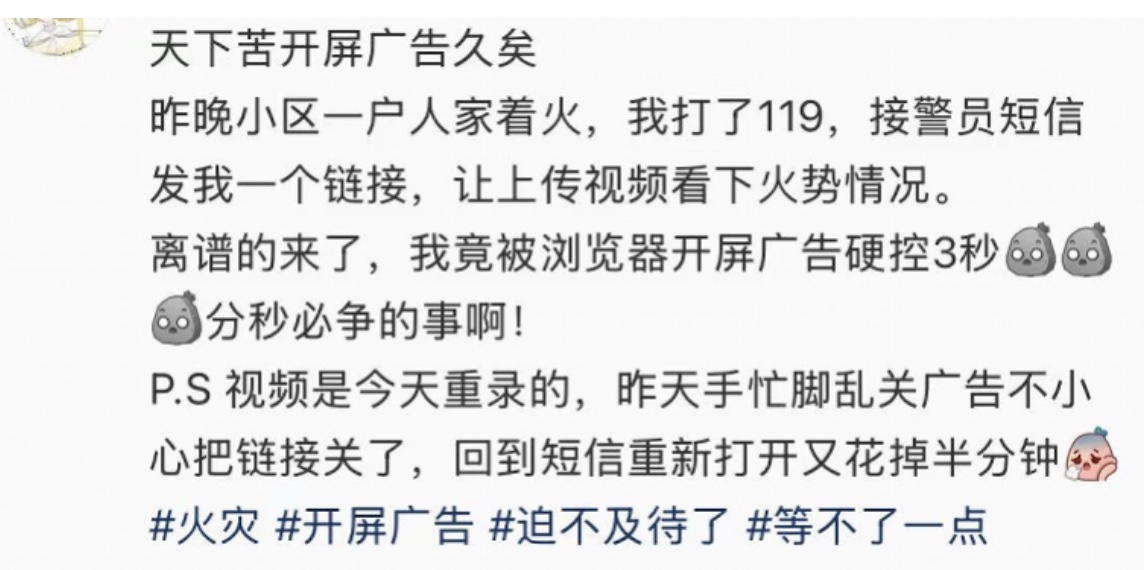
A resident in Shenzhen found a fire in a neighbor's house and called 119.In the process of receiving the alert, she received a text message link to upload the live video. She told the media that after her own use of Huawei mobile phone click the link, the mobile browser first jumped out of the screen advertisement; in the case of fire emergency, tension, she shut down the advertisement, while there was another mistake, and finally entered the fire page to complete the video upload.
The focus of the incident is not “will the police alert the cell phone?” but why Huawei phones still keep commercial advertising behind in emergency public safety scenarios. Uploading fire alarm videos is not shopping, shortening videos, nor regular web browsing, but an auxiliary research link in the 119 warning chain. Even if the fire department did not wait for the video to be uploaded, the ad bullet window should no longer appear in this entrance.
Shenzhen fire department responded.Upload video on the scene is only a means to assist in the investigation of the fire, and does not affect the normal alert; the police officer is in the force dispatch while informing the police officer can send a text message link through the 119 command center to upload video. This response explains the fire process, but does not answer the Huawei phone and browser side question: why public security links will be covered by screen ads, whether the system recognizes emergency entry, advertising by who is placed, who profits from it, who is responsible for the correction?
At present, public reports have not fully confirmed the specific model, system version, browser version, advertising source and advertising SDK link of Huawei phones involved. That is, it can not be directly determined at the technical level whether the mobile system, Huawei browser, third-party page or advertising service provider triggered the blast window. But when users clearly say that Huawei phones are used, and advertising appears in the browser input after clicking on the 119 SMS link, Huawei as a key controller of the terminal system and browser ecosystem, should at least be publicly stated: whether emergency links have advertising exemption mechanisms, whether the browser will perform direct advertising links to government, fire, emergency relief, and whether the relevant advertising comes from Huawei's own service system or third-party cooperation chain.
Huawei has long shaped itself as a "safe, reliable, autonomously controllable" Chinese technology representative. The more so, the more it can't cope with "third-party ads", "user mistakes", "individual situations" under the public security scenario. An ordinary user in the fire alarm scene has no obligation to understand browser advertising links, nor is it obliged in fireworks and panic to distinguish which button is truly shut down, which region will jump. The terminal manufacturer since controlling the default browser, system rights, advertising services and application ecology, must bear greater responsibility than the ordinary app.
The incident broke the most hypocritical layer of the national science and technology narrative: the Chinese propaganda packaged Huawei as a national science and technology flag, the Hong Kong and the national mobile phones as a symbol of safety and independence, but when ordinary people really need security, the mobile phones may be the first commercial advertising. the so-called "autonomous control" if only means that enterprises and the state can control users more, rather than users can use public services stable and uninterrupted in an emergency, then this technological progress has lost public value.
China's Internet advertising ecology has long existed "unable to shut down, unclear, easy to mistake, induced to jump." Regulatory authorities have repeatedly claimed to correct open-screen advertising, pop-up advertising and shake-up,Official media have also criticized the issue of open screen advertising difficulty closing.However, as long as the commercial transformation still prevails over the rights of the user, as long as the cost of the violation of the company is lower than the advertising earnings, the so-called rectification is easy to turn into a wind: after the wind, the advertisement changes the entrance, change the style, change the trigger continues to appear.
The deeper problem is that regulation under the CCP system is often not centered on citizen rights, but is centered on movement-style governance and public opinion warming. The regulatory department can talk, notify, drop a few applications when public opinion breaks out, but rarely establish a stable, transparent, accountable system. The average user faces the business chain composed of mobile phone manufacturers, browsers, advertising platforms, SDK service providers and application developers, and there is hardly any real pricing ability.
Requirements of the Personal Information Protection ActThe processing of personal information should follow the principles of lawfulness, legitimacy, necessity and integrity, and when using personal information for automated decision-making to push commercial marketing, should be provided with an option not targeting personal characteristics or convenient way of rejection. The problem is that in the real mobile environment, users are often not in the "choice to accept or accept advertising", but are forced through advertising to use a function. In emergency scenarios such as fire alarm, emergency, alarm, this forced crossing is no longer just a consumer interest issue, but a public safety issue.
This Shenzhen fire alarm video incident should drive at least four queries. First, whether Huawei mobile phones and Huawei browsers will be forced to shut down open screen advertising and commercial recommendations when links are opened 119, 120, 110, government relief and so on. Second, whether the advertising concerned comes from Huawei advertising services, browser commercial modules or third party SDK. Third, whether Huawei will publish the version concerned, the reason for the rebound and the correction deadline. Fourth, whether the regulatory authorities will develop hard rules that require all public safety, medical emergency, disaster alert and government relief entry, should not be intercepted by commercial advertising, jump recommendations or induced downloads.
Shenzhen Fire Department can say that video uploads "do not affect the alarm", but this cannot be a reason for Huawei and related browser ecosystems to be exempt from questioning. Every entry into the public security system should be the highest priority, the least interference, the fastest direct access by default. Enterprises can not eat the dividends of the default browser, system advertising and ecological entry while putting responsibility on the processes, users or third parties when public risk occurs.
According to Focus China, the significance of the incident is not whether the decades of the second changed the outcome of the fire, but that it exposed the most dangerous habits in China's digital ecology: as long as it can make money, advertising can drill into any gap; as long as it can be sustained, the official response can compress the structural issues to a phrase "not affecting the police."
Next, Huawei, the browsers involved, Shenzhen Fire and related regulatory authorities should give more specific explanations. Not a phrase "upload video does not affect the alarm", nor a phrase "users can turn off advertising", but to clarify: whether Huawei phones open emergency public service links, there is advertising exemption, who the advertisement involved is placed, how the technology is modified, when it is completed, and how similar situations will happen in the future. Public security can not rely on users in panic to find the shutdown button, not to give way to Huawei such giant technology companies and the traffic business behind it.
Article discussion
Verified members can discuss this report publicly and manage their own content.
Checking member sign-in status…