

September 21st, > Major General Bob Littlell, Commander of the Arctic of the United States Coast Guard, indicates and the United States is “very closely” monitoring the activities of Chinese research vessels in Alaska and the surrounding Arctic. Since 2026, four Chinese research vessels have been operating off the United States Arctic, close to five in the whole of
- Most of these vessels are located in international waters, but some of them are located in areas above the United States exclusive economic zone and on the extended continental shelf, and the United States side has therefore included scientific expeditions, seabed resource surveys and potential military uses in its assessment.
Such navigation does not in itself amount to a violation of the law. (b) Foreign ships may legally cross the waters above the exclusive economic zone and the extended continental shelf; What is really sensitive is that, if a vessel conducts marine scientific research, seabed mapping or resource surveys, the coastal State has specific rights in the relevant maritime area. The United States Coast Guard publicly stated in July this year that, while China's Sheron and Sheron 2 were crossing the Bering Sea northward, the United States had dispatched patrol ships to conduct continuous surveillance to ascertain whether their activities were in accordance with international law.
The Bering Sea is only an entrance, and what really matters is that the Arctic Ocean is becoming a usable space
The reduction of Arctic sea ice has made the long-term frozen routes and seabed resources increasingly of real value. China is not a coastal Arctic State, but has defined itself in policy documents since 2018 as a “near Arctic State” and has promoted the so-called “Little Silk Road”. The research vessels are thus not only tasked with climate and marine research, but also to help China to accumulate shipping lanes, hydrology, sea ice, seafloor topography and resource data.
These data are of their own clear dual use. Accurate seabed topography can serve resource development or help submarine navigation; Ocean-temperature salt structures are the basis for climate research and influence the sound transmission; Sea ice data can support both civilian route planning and polar ship operations. This does not mean that every Chinese science examination is a military mission, but rather that in strategic space such as the Arctic, scientific data are difficult to separate from security values.
This year's change is the fact that activities are coming closer to the United States' own rights
July 12, when the United States Coast Guard called the "Selon" crossed the United States exclusive economic zone northward and across the United States extended continental shelf; The Snowlon 2 also sailed to the Arctic during the same period. The United States side stressed that the passage of foreign vessels through those waters was in itself consistent with international law, but that prior authorization and sharing of relevant research information was required in the event of marine scientific research being carried out in the United States exclusive economic zone or extended continental shelf.
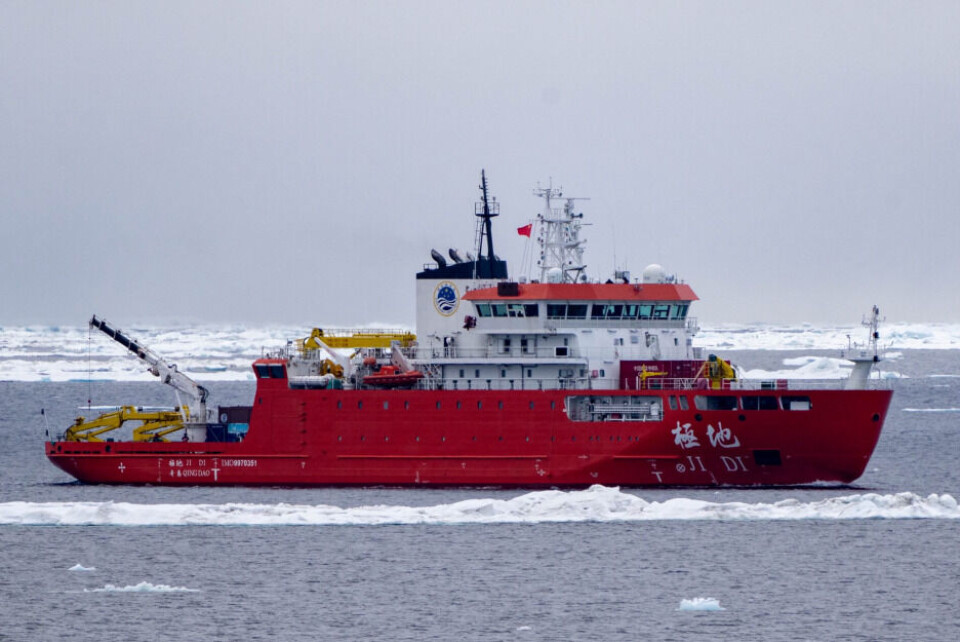
In 2025, the United States Coast Guard also sent to watch Chinese research vessels such as the Healy Breathing Ship and the Nakayama University Polar. The Polars, among them, were active 265 miles north-west of Alaska Utchavik. Such research vessels are more likely to stay on a scientific mission for long periods of time, repeat measurements and accumulate data than traditional warships, and United States security agencies are therefore more concerned with their operational content than with their flag and course.
原始来源 · en.highnorthnews.comChinese Research Vessels Enter U.S. Extended Continental Shelf in Arcticen.highnorthnews.com ↗The Arctic layout in Beijing is also working with Russia.
China ' s activities in the Arctic are not carried out in isolation. In the past few years, the Russian and Chinese air and sea forces have conducted joint cruises and exercises in the Bering Sea, near Alaska and on the outer edge of the Arctic. Cooperation also exists between the two sides in the areas of energy, shipping and polar infrastructure.
But it is equally inaccurate to see China and Russia simply as a fully integrated Arctic alliance. There are also differences between the two countries in the areas of route control, resource interests and Arctic governance. Russia views the northern channel as a highly sensitive sovereign and economic asset, while China wants more stable and open access and investment opportunities. This co-existing cooperation complicates the security landscape of the Arctic.
The real concern of the United States is that scientific research has accumulated into long-term “regional familiarity”
While it is difficult to change the balance of power in a single examination, many years of repeated access to the same sea area by different vessels can generate a wealth of basic data and operational experience: where there are sea ice cracks, how the seafloor topography changes, how communications and navigation conditions are, which ports are resupplyable and which shipping lanes are available at different seasons.
This “regional familiarity” is itself part of national capacity. For a large country that wishes to expand the range of naval activities in the ocean, ensure energy transport and participate in the competition for Arctic resources, the scientific system can do much more to prepare for the ground ahead of time without military deployment.
There is no public evidence that four Chinese research vessels have conducted illegal military reconnaissance this year. Major General Little's statement reflects more of a long-term security judgement: when scientific research, resource surveys and national strategic objectives are superseding on the same ship and agency, the United States assesses “lawful presence” separately from “potential use”.
The Arctic dispute will end up in the rule, not in the nationality of the ship
The political position should not determine whether a Chinese research ship could enter the Arctic. What is really needed is clarity as to the area in which the ship is located, what activities it has carried out, whether it needs permission from the coastal State, what data it has collected and whether the data are shared in accordance with international rules.
If these activities are exclusively open scientific research, transparent navigational programmes, scientific project descriptions and data sharing can reduce security concerns; Where seabed resources, military mapping or other sensitive tasks are involved, States will take more robust surveillance measures in accordance with their national rights and international law.
The presence of four Chinese research vessels off the coast of the United States of America this year shows that the Arctic is moving from a future issue to a reality. The ice is retreating and the number of ships is increasing, making it more difficult to delineate the boundaries between science, commerce and military.
Article discussion
Verified members can discuss this report publicly and manage their own content.
Checking member sign-in status…