
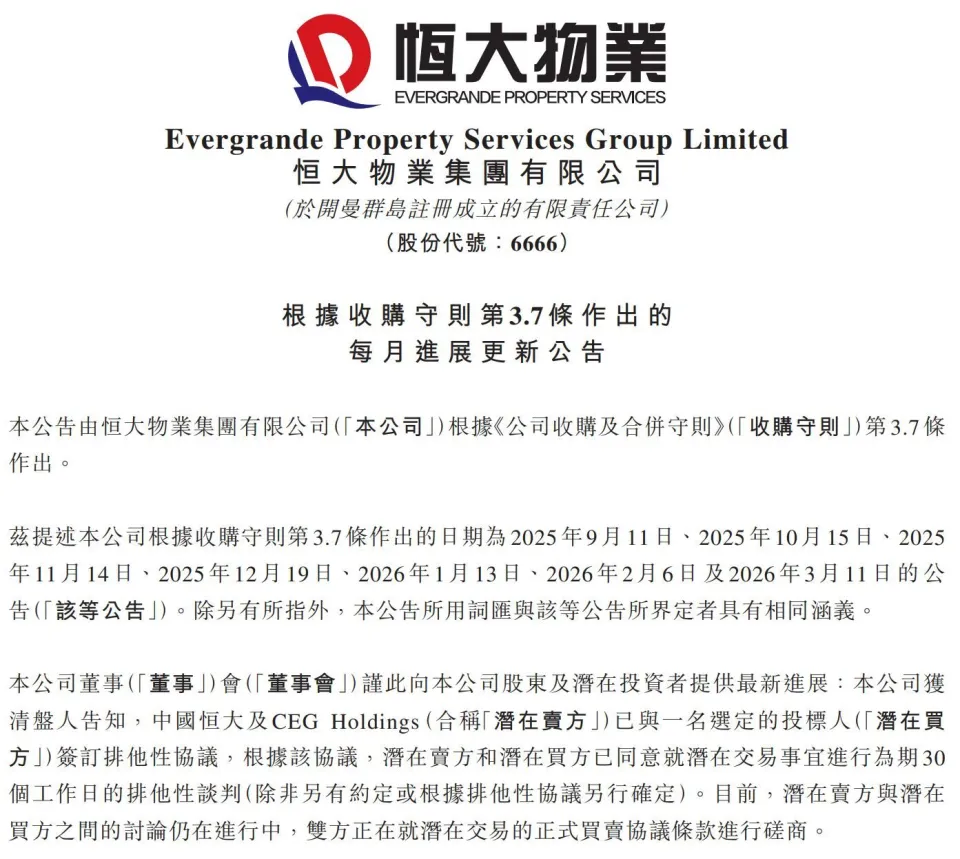
On 30 September, the Hendron Property Services Group disclosed that the CEG and CEG Holdings (BVI) quellings of China had signed an exclusive agreement with a selected bidder to continue negotiations on the sale of a total of 51.16 per cent of the hendium property holdings. Reuters quoted the company ' s announcement and the exclusion period continued until 27 October; At the time of the publication of the bulletin, the parties had not signed a formal sale agreement and the identity of the purchaser and the price of the transaction had not been disclosed.
This step moves the disposal of a constant asset to a more specific stage of negotiation, but does not mean that the transaction has been completed. The hemogenous property industry has been updating the progress of potential equity sales through HKO since 2025; This exclusionary negotiation means that the clearing-house will concentrate on a selection of buyers for the time being, and that the formal conclusion of the deal will still depend on the agreement, the supervisory procedure and the payment arrangements.
A property equity deal, which is still backed by a $300 billion debt stock.
China ' s debt default of approximately $300 billion since 2021 was subsequently cleared by a court order. Unlike real estate development, the hemogenous property industry relies mainly on income from the continued property services of residential, commercial and public facilities, and thus retains independent operating value after the parent company ' s debt crisis.
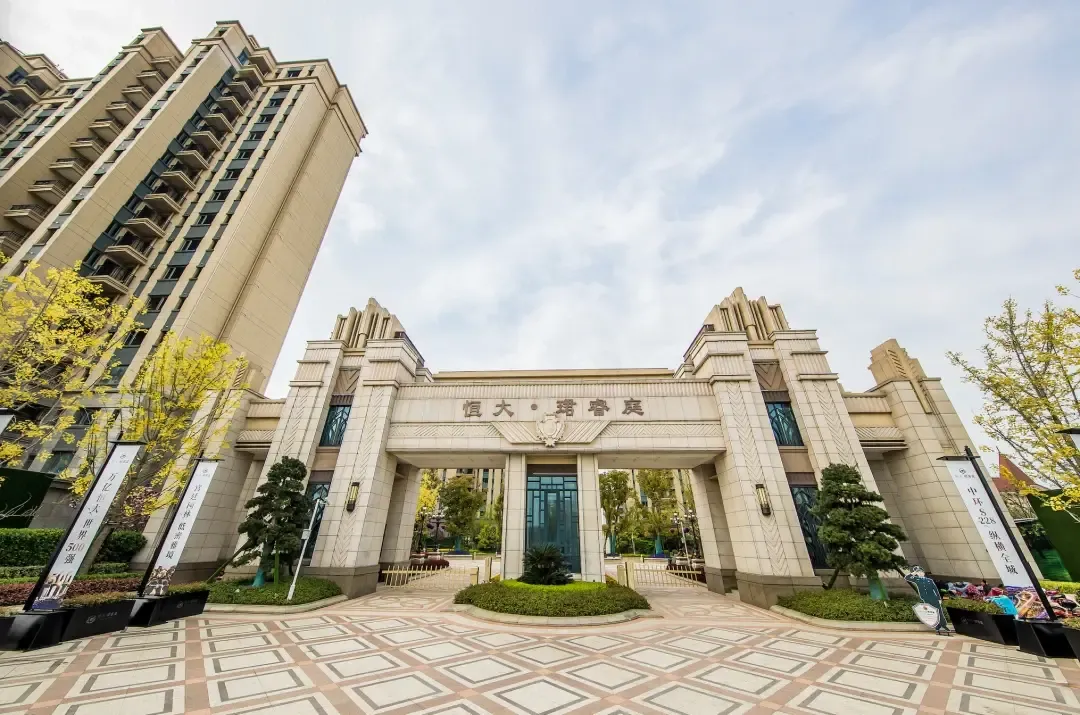
The Hendricks Property Network shows that as of 31 December 2025, the company had nearly 300 cities with an area of approximately 579 million square metres of piped water, with over 3,000 management projects serving approximately 3.95 million owners. The clearing-house person sells 51.16 per cent of its holdings, which is in essence a way of converting this ongoing business asset into a cash or transactional value that can be distributed to creditors.
The ongoing crisis is not a simple business management story
In its 2026 Fourth China Consultation Report, the International Monetary Fund noted that the effects of real estate adjustments in China have exceeded the balance sheet of the developer: the pre-sale system makes home-buying households important creditors of developers and presale houses that are not completed still pose a risk; The sub-real estate sector also shocks local finance through land-transfer revenues and local financing channels. At the same time, IMF noted that the Chinese authorities had supported project delivery through policies such as “white lists” of “back-to-back buildings”, but still needed to deal with developers and a large number of unfinished projects that could not be sustained.
原始来源 · elibrary.imf.orgIMF:People’s Republic of China 2025 Article IV Consultationelibrary.imf.org ↗This means that a constant clean-up cannot be understood as a mere failure of a private developer. In the past, local governments in China had long relied on land for their income, while real estate had multiple functions such as investment, local finance and the storage of wealth of the population; Developers are highly leveraged, pre-sale financing and local land finance are mutually reinforcing. Industry risk was concentrated after authorities tightened the financing constraints of developers between 2020 and
- The IMF considered that the leverage itself was necessary, while noting that the institutional dependence and pre-sale risk that had been developed previously required a more thorough reorganization.
The ultimate loss to whom the loss is borne is more important than the liquidation
While the sale of a permanent property equity, if completed, could increase the recovery of inventory assets, a single transaction could not resolve a persistent and large debt gap. The losses incurred by creditors, suppliers, home buyers, local financial and financial institutions are not the same, and the way in which they are ranked and distributed is one of the central public issues in the disposal of real estate risks.
For home-buying families, the first issue is whether the pre-sale housing can be delivered; For local governments, it is a decline in land revenues and related debt pressures; For creditors, the amount of assets that can eventually be recovered is the amount of money that can be recovered from the inventory. China’s real estate governance has for many years been placing market expansion in a deep relationship with local fiscal and policy objectives, so that crisis management is not just a self-explanatory market, but requires a regulatory, fiscal and judicial system to decide on how costs are to be distributed.
The exclusion agreement is not the end point, and transparency remains the focus of next observation
The most critical legal fact of the 30 September proclamation remains that the parties have not signed a formal sale agreement. The next step would require the identification of the purchaser, the final transaction price, the manner in which the funds were paid, regulatory approval and how the proceeds of the transaction entered the pool of ever-changing assets.
The crisis has been a constant one for many years. For a market that is shaped by a highly administrative land system, local financial dependence and real estate financial policies, what is really worth monitoring is not just who the big and persistent property will ultimately sell to, but how the oversight will intervene when risks arise, who will receive relief after exposure, who will bear the loss, and how much information and security the buyer will receive throughout the clean-up and restructuring process.
Article discussion
Verified members can discuss this report publicly and manage their own content.
Checking member sign-in status…