
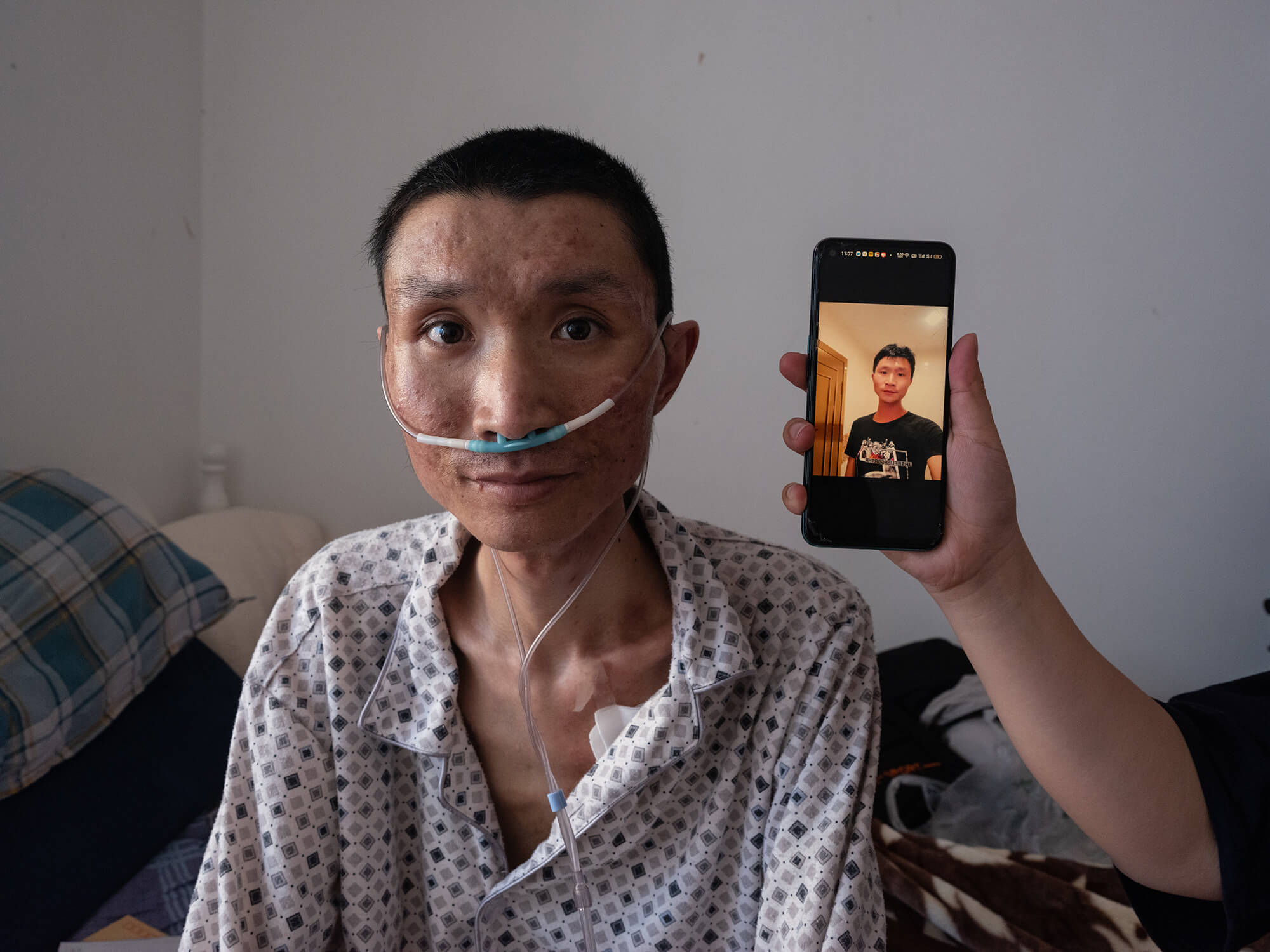
From 25 August to 8 September, several hundred workers of the Chongqing festival of dust and pulmonary disease travelled to the county Human Resources and Social Security Institute to defend their rights in collective cases, demanding medical treatment, living allowances and cover-up guarantees. In live videos, workers gathered outside the community sector, with hand-held materials and repeated accounts of their exposure to dust and pulmonary disease after many years of work under the Fong-Hong-Hong and the Coal Coal Coal Coal Coal Co-Face.
They do not ask for temporary additional benefits. In 2022, the " Implementation Programme for the Treatment of Persons Diagnosised as Pneumoconiosis after the Closure of Coal Mine Workers in Phuong Phuong Phuong County " (No. 2022
- was jointly published by such multisectoral bodies as the Phuong Phui County Health Board, which included such workers diagnosed with pneumoconiosis after the closure of the mine in the special living allowance, employment hardship benefit and medical treatment. The earlier policy system also included special care and assistance arrangements for workers diagnosed with octopus and pulmonary disease after their release from work.
Four years later, hundreds of patients still need to be at the SWD door to explain that the issue of the vasectomy has shifted from “the existence of a policy” to “why it has not landed”.
原始来源 · yesterdayprotests.com重庆奉节数百尘肺矿工集体维权,要求当局兑现救治政策“昨天”整理现场资料及2022年奉节尘肺病救治救助方案背景。yesterdayprotests.com ↗A paper-based solution will not solve the dust that's already in the lungs
Many of these miners have been engaged in underground coal mining for a long time, working in the dust and aluminum environment. From 2005 to 2021, coal mines in Fong Fong-hye and Voodoo Creek were closed down. The mine can be closed and occupational diseases do not disappear with the enterprise. Dust pulmonary disease has long-term insulated and irreversible characteristics, with some workers leaving the mine for years to be diagnosed and the employer may have written off, bankrupt or lost capacity to pay.
This is why special assistance mechanisms were set up in the wake of the festival: while traditional work injury insurance is based on labour relations, insurance records and occupational disease identification, it is often the old miners whose work relations are difficult to prove, whose businesses have disappeared, whose diagnosis has been delayed, who are most in need of protection after the closure of the mine.
The policy design therefore has a clear mandate
- not to let the responsibility for occupational harm disappear with the enterprise because the mine is closed.
The section is not “no money”: in 2025, special funds were issued for relief.
According to a June 2025 public document of the Phuong County Finance Authority, the District Health and Safety Commission (SHRC) applied for a county-level grant of $361818.21 for rehabilitation and treatment of Pneumonia patients in the first quarter of the year, under the programme for special care and assistance for pneumococcal diseases, which requires “regulating management and ensuring that funds are earmarked”.
原始来源 · cqfj.gov.cn奉节县财政局关于下达尘肺病患者康复2025年一季度救治救助资金计划的通知奉节县财政局公开文件显示,2025年一季度下达尘肺病患者康复救治县级补助资金361818.21元。cqfj.gov.cn ↗This financial document is very important because it shows that the mechanism for providing assistance for pneumoconiosis has not been abolished on paper and that special funds are still being arranged for the county-level finances.
The problem is thus more specific: Why do hundreds of miners still have to travel to government departments for many days to defend their rights, given the existence of policies, the existence of funds and the existence of the responsible departments?
At the heart of workers ' public statements is that the existing policies of relief and underdevelopment are not being fully implemented. For a person with a long-term oxygen, drug use and repeated hospitalization, it is not important that the policy “in principle” be covered. What really determines survival is whether the benefits are paid on a monthly basis, whether the medical expenses are sustained and whether the living difficulties are actually covered.
Teams at the front of the Human Welfare Bureau, exposed to the most vulnerable areas of multisectoral policy
The provision of sacrificial assistance is not a matter that can be done by the department alone. The diagnosis of occupational diseases involves the health system, the system of social welfare is concerned with the identification and treatment of injuries at work, medical care and institutions are concerned with medical expenses, the hardship benefit is concerned with civil or related under-the-ground mechanisms, and the financial services are responsible for the financing of the programme.
Policy is written as “multi-sectoral integration”, which in administrative texts means synergy; In the case of implementation, it is also easy to turn into responsibility for cutting. The patient is often not faced with a whole country, but with a window: the matter is a matter for the health, for the community, for the financial and medical resources, and for medical care.
For a healthy person, this is a cumbersome procedure; For those who have already experienced respiratory difficulties and movement restrictions, it may be an impossible threshold.
According to the public information of the Phuong Dzhu Government, in February 2026 institutions such as the District Social Security Services Centre, the Employment and Talent Centre and the Labour Personnel Disputes Arbitration Institute were moved to the Human Resources Services Industrial Park, with the official reason for increasing the efficiency of the Human Resources Social Security Service. On 28 August, during the miner's rights campaign, a symposium on industrial injury insurance in parts of Chongqing Districts was held in Fong. The Conference emphasized the three pillars of “prevention, compensation and rehabilitation” and called for the protection of the legitimate rights and interests of workers.
原始来源 · cqfj.gov.cn重庆市部分区县工伤保险工作座谈会在奉节召开奉节县政府公开信息显示,8月28日当地召开工伤保险工作座谈会,强调预防、补偿、康复和劳动者权益保障。cqfj.gov.cn ↗The same county, on the one hand, discussed “efficiency efficiency” in industrial injury insurance in the conference room and, on the other hand, hundreds of dust and pulmonary miners repeatedly approached the Human Welfare Department to demand that the already existing rescue policy be honoured. The distance between the two images is the most striking gap in the management of occupational diseases.
From the closure of the coal mine to the bottom of the occupational disease, the Government has taken over the final responsibility
The most common push logic in cases of pneumococcal disease is to ask whether the original enterprise still exists, whether the labour relationship is complete and whether it was insured in the year in question. But the special relief system itself, which was subsequently set up under the FAS, was designed to address these historical legacies. Since local governments have taken over responsibility for the trade through special programmes, they cannot allow miners to return to the “no business, no labour relations, no employment injury” point.
The typical case of administrative inspection published by the Supreme Inspection also addressed the issue of the inability of persons with pneumoconiosis from the closure of the mine in Chongqing to benefit from the industrial injury insurance in a timely manner. In the case of the local authorities, the recommendations of the prosecution have led to the establishment of special assistance mechanisms for the institutionalization of medical care, life assistance and employment assistance. The public material even stated that the persons concerned would “continuously benefit for life”.
If the policy is to be implemented only by hundreds of patients coming together to the Government, the so-called “dash” is still actually based on the capacity to defend rights: those who can come out, organize, and see the outside world are better placed to be dealt with; Those miners who are more ill, have less mobility and do not use social media may be the most vulnerable to being left out of the system.
The only thing that needs to be tracked is not a response, but four accounts
The next four sets of data are most needed for this incident to be made public.
First, how many of the patients diagnosed with dust and lung after the mine has been closed off, how many have been included in the 2022 rescue programme and how many are still waiting for it.
Second, the amount of the allowance, the allowance for hardship in employment and the medical assistance, respectively, are payable and actually paid, and there are no suspensions, omissions or changes in standards.
Third, from 2025 to 2026, how much money was actually allocated by county and higher-level finance for the provision of assistance for pneumococcal disease, and how much money had been paid to the patient and how much had been left.
Fourth, what are the responsibilities of health, social, health, finance and townships, and which department is ultimately responsible for correcting the non-payment of benefits.
These are not technical details, but the only way to reach the human being.
The grass-roots governance of Xi Jinping is not lacking in documents, but in external forces that make them truly binding on ordinary people
The cases mentioned above are the most illustrative of a long-standing problem of grass-roots governance in China: policies can be jointly developed by multiple sectors, financial resources can be earmarked, and government reports can even write “experience” in the treatment of dust and pulmonary diseases, but the beneficiaries themselves still lack the capacity to organize independently, monitor continuously and participate in the implementation of policies.
Miners do not have independent trade unions to negotiate on their behalf for long periods of time, and there is no independent media to follow up on every relief fund. The Administration both develops policies, maintains lists, reviews qualifications and determines how funds are disbursed. In a situation where patients can still rely on visits, grouping, network exposure and complaints to higher levels of the sector, problems arise.
Under this structure, the implementation of policies depends to a large extent on the willingness of the administrative system itself to correct the bias rather than on the beneficiaries having sustainable institutional checks and balances.
This is the point of the hundreds of pneumoconiers standing at the door of the Human Welfare Bureau: they are not asking the Government to reformulate a policy, but to implement the commitments it has already written.
The coal mine has been closed and the workers ' lungs have not been able to recover. For the Phuong Dzongkhag, it is not a real responsibility to hold another coordination meeting, but to make the list, criteria, funds and results of the distribution public, so that everyone who has been trading their lungs for coal production knows whether the rescue mechanism has included themselves.
Article discussion
Verified members can discuss this report publicly and manage their own content.
Checking member sign-in status…