
The case of the National Security Law of the Hong Kong Confederation has entered the sentencing phase. On August 28, the High Court of Hong Kong heard the apologies of Li Jiang, Zhou Jian, and Ho Jian Jin. Li Jiang and Zhou Jian were previously convicted on August 21 of "inciting a crime of subversion of the state regime", while Ho Jian Jin had confessed guilt in January this year.
The core of the case is not whether there is violence, but whether the long-standing political arguments put forward by the Confederation can be defined as “subversion” by the National Security Law. The Hong Kong Court ruled in its ruling that one of the Five Major Programmes of the Confederation, “end the one-party dictatorship,” meant to overthrow the fundamental system established by the Communist Party of China and the Chinese Constitution, and thus constituted the intention of “subversion of the state regime.”
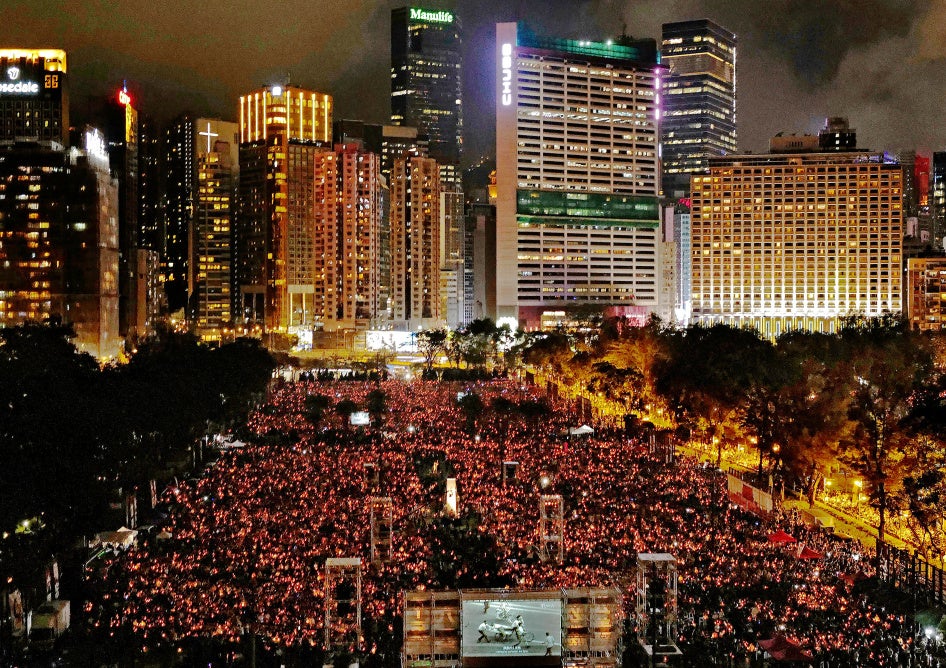
Image: On June 4, 2019, the Six-Four Candles Party was held in Hong Kong's Victoria Park. Image from Human Rights Watch's original report, originally copyrighted as AP Photo/Vincent Yu, File.
The Hong Kong Special District Government welcomed the conviction and publicly stated that the leadership position of the Communist Party of China is at the heart of China’s constitutional order, and that any attempt to overthrow that leadership position could affect national security laws.
This official stance is in sharp contrast to the assessment by international human rights organizations. Human Rights Watch noted that Li Xiao and Zhou Zhou have long been involved in organizing the Six-Four Candles Party in Victoria Park, and that the Association has held annual commemorative events since 1990 until it was banned and eventually dissolved after the implementation of the Hong Kong National Security Act. Human Rights Watch believes the conviction of the two is a violation of freedom of speech and the right to peaceful assembly, and warns that the Six-Four Commemoration in Hong Kong has gradually turned from a public memorial space to a criminal risk.
Human Rights Watch reports showed that on June 4, 2019, tens of thousands of citizens were still able to light candles at Victoria Park to commemorate the 1989 deaths of the Six-Four. It was one of Hong Kong's last large-scale public Six-Four commemoration events. Since then, officials banned the 2020 and 2021 parties for vaccine prevention, and the Association was then forced to dissolve and the space for public commemoration continued to shrink.
The European Union expressed concern over the August 21 judgment, saying the case further demonstrated that Hong Kong’s freedom of speech, freedom of assembly and the space of independent civil society are shrinking.The European Union noted in particular that the defendant has experienced prolonged pre-trial detention and refusal to be released on bail, and that Jiu Zhou has been detained separately several times, and that these circumstances have undermined external confidence in Hong Kong’s guarantee of the rule of law.
The August 28 apology procedure brought the case into the final sentencing phase. The Associated Press that Zhou Zhou said in court that pursuing democracy should not be considered a crime and that he would not give up his belief even in prison. The judge said the sentence would be announced within two weeks.
From the perspective of Human Rights Watch, the case is more important than the three defendants themselves. The Confederation has long assumed the role of preserving the historical memory, organizing public memories and promoting accountability. After the court incorporated political claims such as “end to one-party dictatorship” into the subversive category of the National Security Law, the boundaries between Hong Kong’s previously protected political expression, historical memory and civil society activities were further compressed.
But in fact, it is also necessary to distinguish between court judgments, government positions and human rights organization assessments. The court has made a judgment of guilt, which is a legal fact; the Hong Kong government considers that relevant activities endanger national security and is an official position; Human Rights Watch and the European Union consider the case to violate fundamental freedoms and have a political repressive nature.
The next step that is most concerned is whether the court will further define the legal relationship between the "end of one-party dictatorship" and the Six-Four Memorial and the Peace Political Initiative in the sentencing grounds.If the sentence is close to the high sentence range under the National Security Act, it will further strengthen external concerns about the shrinking space of political expression in Hong Kong.
Article discussion
Verified members can discuss this report publicly and manage their own content.
Checking member sign-in status…